Mouth breathing problems are quietly destroying your sleep, your microbiome, and your health
I've been a dentist for over 18 years. And one of the patterns I kept seeing — over and over — was patients coming in with recurring gum inflammation, dry mouth, persistent bad breath, and cavity after cavity, despite brushing twice a day and doing "everything right."
When I started looking deeper into their health histories, so many of them had one thing in common: they were mouth breathers. And nobody had ever connected that dot for them.
Mouth breathing problems are far more common than most people realize — and far more consequential.
In this article, I'm going to walk you through what actually happens inside your body when you breathe through your mouth instead of your nose, how it affects your sleep, your oral microbiome, and even your gut health — and what you can start doing about it today.
(And if you're someone who wakes up exhausted, has brain fog you can't shake, or has been told your gums "just aren't great" — I think this will resonate with you in a big way. Stick with me.)
Key Takeaways
- In children, mouth breathing problems have been documented at a prevalence of 48–57% — and the habit frequently continues undetected into adulthood.¹
- Breathing through your mouth bypasses the nose's natural filtration, humidification, and nitric oxide production — all critical to your immune and cardiovascular health.²·³
- Chronic mouth breathing dries the oral environment, shifts pH, and allows harmful bacteria to outcompete beneficial ones — a state called oral dysbiosis.³·⁴
- Oral dysbiosis doesn't stay in your mouth; bacteria travel from your mouth to your gut with every swallow, affecting your gut microbiome and systemic inflammation.⁴
- Untreated sleep-disordered breathing is strongly associated with cardiovascular disease, metabolic dysfunction, and cognitive decline.⁵
- Sleep apnea — often rooted in airway problems — is directly linked to disrupted gut microbiota.⁶
- Testing your oral microbiome is the most precise way to understand the bacterial damage already done — and to start reversing it with targeted protocols, not guesswork.
You Might Be a Mouth Breather and Not Even Know It
Here's something I tell my patients: most people who have mouth breathing problems at night have no idea.
You're asleep. Nobody's watching. But your body is keeping score.
Some of the most common signs you are a mouth breather:
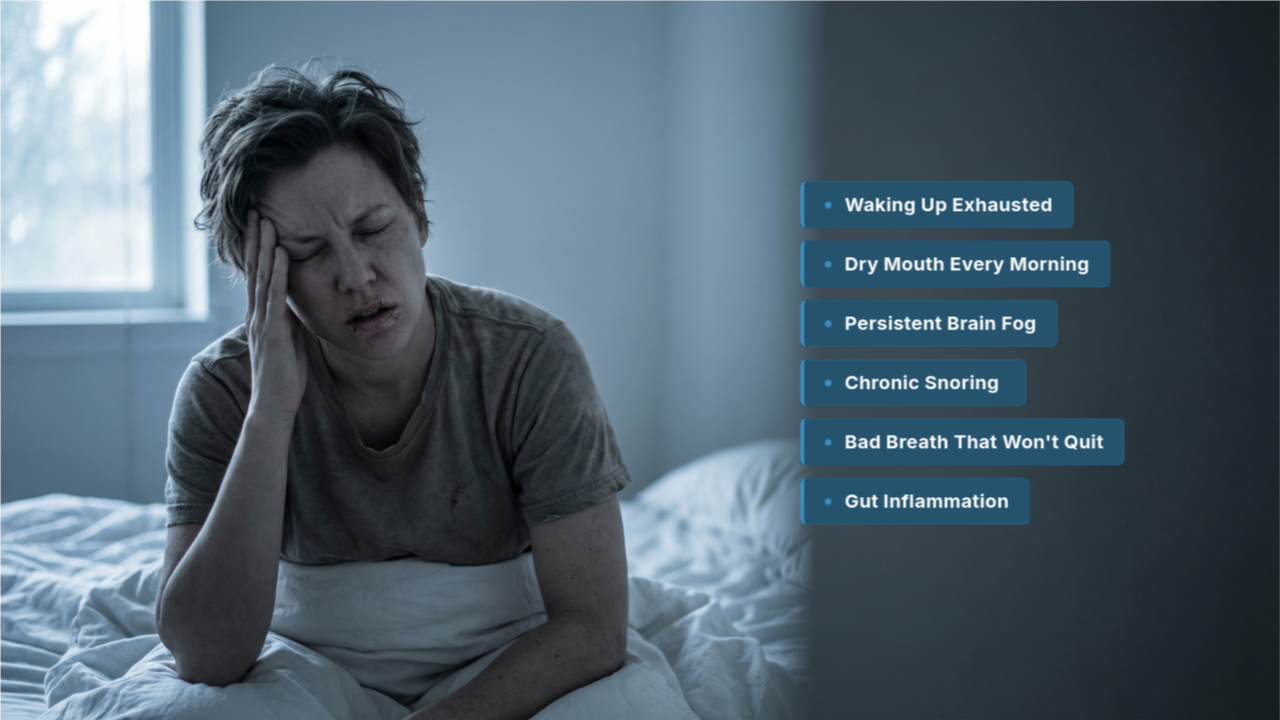
- Waking up with a dry mouth or sore throat
- Bad breath that persists despite brushing
- Snoring, or being told you snore
- Waking up tired even after a full night's sleep
- Chronic congestion or feeling like you can't breathe through your nose
- Needing to take frequent sips of water
- Teeth grinding (bruxism)
- In children: open mouth posture during the day, dark circles under the eyes, or crowded teeth
If three or more of these sound familiar, your airway is worth paying attention to.
Research published in Frontiers in Microbiology found that mouth breathing causes measurable alterations in oral — nasal — pharyngeal microbiota, with opportunistic pathogens increasing in relative abundance in the mouth-breathing group compared to nasal breathers.¹
And that shift matters a lot more than most people think.
What Happens Inside Your Mouth When You Stop Breathing Through Your Nose
Your nose is a remarkably sophisticated air-processing system. It filters, warms, and humidifies every breath before it reaches your lungs.
It also produces nitric oxide — a powerful vasodilator and antimicrobial molecule — primarily in the paranasal sinuses.
Research published in the American Journal of Respiratory and Critical Care Medicine confirmed that exhaled nitric oxide is significantly greater during nasal breathing compared to mouth breathing, and that this molecule plays a direct role in oxygenation and pulmonary function.²
When you switch to breathing through your mouth, all of that is bypassed.³
The result? Dry mouth.
And dry mouth is not just uncomfortable — it is one of the most destabilizing forces in your oral ecosystem.
Saliva is your mouth's built-in defense system. It neutralizes acids, delivers minerals to your enamel, and maintains the delicate pH balance that determines which bacteria get to thrive and which ones don't.
When your mouth dries out, pH drops, and that creates a favorable environment for pathogenic bacteria. Beneficial, health-promoting species get crowded out.
Opportunistic pathogens — the kind linked to gum disease, decay, inflammation, and systemic illness — move in.³·⁴
What Happens When You Stop Breathing Through Your Nose
👃 Nose Gets Bypassed
Your nose filters, warms, and humidifies every breath — and produces nitric oxide, a powerful antimicrobial molecule. Mouth breathing skips all of it.
💧 Saliva Dries Up
Saliva is your mouth's built-in defense system — it neutralizes acids and maintains pH balance. When the mouth dries out, that protection disappears.
⚗️ Oral pH Drops
A more acidic oral environment creates ideal conditions for harmful bacteria to thrive — while beneficial, health-protective species get crowded out.
🦠 Oral Dysbiosis Sets In
Opportunistic pathogens linked to gum disease, decay, and chronic inflammation take over — not because of poor hygiene, but because of how you breathe.
⬇️ Bacteria Travel to Your Gut
With every swallow, bacteria from your dysbiotic oral environment travel down into your gut — seeding imbalance far beyond your mouth.
🔥 Systemic Inflammation Follows
Gut dysbiosis drives whole-body inflammation — affecting your immune system, cardiovascular health, metabolism, and cognitive function.
💡 This cascade begins silently — often while you sleep. Testing your oral microbiome is the only way to know how far it has progressed.
A study published in the Journal of Clinical Sleep Medicine found that in individuals with obstructive sleep apnea — representing the more severe end of the sleep-disordered breathing spectrum — oral microbiome diversity was measurably reduced, with dysbiosis documented in moderate to severe cases.⁷
The mouth goes from being a guardian to a source of harm — not because of poor hygiene, but because of how you're breathing.
I've had patients who were genuinely meticulous about their dental care. They flossed, they used fluoride-free toothpaste, they were diligent.
And yet their gums kept bleeding, their breath kept coming back, their dental bills kept climbing.
When we looked at the airway connection, everything made sense. Oral health and sleep quality are not two separate conversations. They are one.
The Sleep Connection — Why Airway Health Wrecks Far More Than Your Rest
Most people think of sleep problems as a sleep problem.
I'd invite you to think about it differently: untreated airway dysfunction during sleep is a whole-body health crisis happening nightly, in silence.
Obstructive sleep apnea (OSA) affects between 9% and 38% of adults globally, and is strongly associated with cardiovascular disease, metabolic dysfunction, and cognitive decline.⁵
In patients with drug-resistant hypertension specifically, the prevalence of OSA has been reported at 65–80%.⁸
And here's where it gets particularly relevant to everything we focus on at Gateway to Health: sleep-disordered breathing directly disrupts your gut microbiome.
Research has found a robust association between the severity of intermittent oxygen desaturation during sleep and pronounced gut microbiota dysbiosis.⁶
In other words, the worse your airway function at night, the more your gut bacteria are thrown out of balance.
Beneficial short-chain fatty acid-producing bacteria decline. Opportunistic pathogens increase. Systemic inflammation follows.⁹
The Mouth-Sleep-Gut Cascade
Three systems. One chain reaction. And it often starts the moment you fall asleep with your mouth open.
System 01
The Mouth
What's happening: Chronic mouth breathing dries the oral environment, shifts pH, and displaces beneficial bacteria — creating a breeding ground for pathogens linked to gum disease, decay, and inflammation.
Reduced oral microbiome diversity
Loss of nitric oxide production
Pathogen overgrowth with every swallow
↓ Bacteria travel from mouth to gut with every swallow ↓
System 02
The Sleep Airway
What's happening: Airway obstruction during sleep causes repeated oxygen drops — a condition called intermittent hypoxia. Research links the severity of these drops directly to the degree of gut microbiota disruption.
Disrupted sleep architecture and recovery
Oxygen desaturation stresses gut bacteria
OSA affects 9–38% of adults — most undiagnosed
↓ Oxygen disruption cascades into gut dysbiosis ↓
System 03
The Gut
What's happening: Beneficial short-chain fatty acid-producing bacteria decline. Opportunistic pathogens rise. The result is gut dysbiosis — a state that drives systemic inflammation throughout the entire body.
Decline in protective gut bacteria
Metabolic and immune dysfunction
Chronic systemic inflammation
↓ Gut inflammation ripples into whole-body health ↓
Whole-Body Health Consequences
Cardiovascular disease risk
Metabolic dysfunction
Cognitive decline and brain fog
Chronic fatigue and mood disruption
💡 The mouth, sleep, and gut don't operate in isolation — they are one interconnected system. Disrupting one disrupts all three.
This is the oral-gut-systemic cascade that we cover in the Gateway to Health documentary series. If you haven't yet watched it, Episode 1 is a great place to start — it lays out the foundational science of how your oral microbiome connects to the rest of your body.
And if you've been exploring the connection between your gut and your overall health, the Interconnected series is available for a limited-time free viewing — it maps the gut-health connections that so many of our patients find transformative.
If you're experiencing brain fog, low energy, bloating, or mood disruption alongside your sleep issues, I'd encourage you to read our article on brain fog causes that start in your mouth and travel to your gut — the overlap is significant.
Airway Dentistry — A Whole-Body Approach to Your Mouth
When I transitioned from traditional dentistry to functional oral health, one of the biggest shifts in my thinking was learning to look at the airway as a central part of my patients' overall health picture — not just a structural issue to flag for a sleep specialist and move on.
Airway dentistry is an emerging field that examines how breathing patterns, jaw development, tongue posture, and sleep-disordered breathing intersect with oral and systemic health.
It's a collaborative, integrative approach — and it works alongside, not instead of, conventional dental and medical care.
Here's how I'd break down the difference in practice:
Two Approaches to Dental Health
The gap isn't about better or worse dentists — it's about which questions get asked in the first place.
Conventional Approach
Treats existing cavities and decay
Reactive care — addresses damage after it has already occurred.
Airway-Informed Functional Approach
Investigates why decay keeps recurring
Looks upstream — oral microbiome, breathing patterns, and root causes.
Gum Disease
Conventional Approach
Addresses gum disease symptomatically
Cleanings and scaling without exploring what's driving the inflammation.
Airway-Informed Functional Approach
Tests for oral microbiome dysbiosis
Identifies specific bacterial imbalances driving gum disease at the source.
Crowded Teeth
Conventional Approach
Documents crowded teeth
Notes the structural issue and refers for orthodontic correction.
Airway-Informed Functional Approach
Considers jaw development and airway
Explores how breathing patterns and tongue posture may be shaping the jaw over time.
Snoring & Sleep Issues
Conventional Approach
Refers snoring to a sleep specialist
The oral-airway-systemic link is rarely explored within dental care itself.
Airway-Informed Functional Approach
Collaborates across disciplines
Works alongside medicine, nutrition, and sleep specialists for whole-body resolution.
Overall Philosophy
Conventional Approach
Reactive to disease
Intervenes after problems have already developed and progressed.
Airway-Informed Functional Approach
Proactive toward optimization
Identifies and corrects imbalances before they become chronic disease.
💡 Your conventional dentist is a valuable part of your health team. The functional approach doesn't replace them — it closes the gaps conventional medicine hasn't yet caught up with.
To be clear: your conventional dentist is an invaluable part of your health team.
The point isn't that traditional dentistry misses everything — it's that the oral-systemic connection has historically fallen through the gap between medicine and dentistry.
As I've explored in our oral-systemic connection article, the 1839 professional split between medicine and dentistry created a structural blind spot that functional oral health is finally beginning to close.
What You Can Do Starting Right Now
The good news: there are meaningful steps you can take today, and most of them cost nothing.
- Practice nasal breathing intentionally during the day.
The more you consciously breathe through your nose while awake — during walks, workouts, even just sitting — the more you reinforce the habit.
Your nervous system learns what normal feels like.
- Address underlying nasal congestion.
Allergies, inflammation, structural issues — these are often what force people into mouth breathing in the first place.
Talk to your doctor or an ENT if chronic congestion is the obstacle.
- Consider mouth taping at night.
This one surprises people.
A small piece of gentle medical tape placed vertically over the lips at night encourages nasal breathing during sleep. It sounds counterintuitive, but it's widely used in functional health and airway dentistry.
Start slowly, and always consult your provider if you have severe sleep apnea before trying this.
- Stay hydrated and support your saliva production.
Dry mouth = bacterial imbalance.
Drinking water throughout the day, especially in the evening, helps your oral environment stay in balance.
- Support your oral microbiome directly.
This is where I always come back to oral microbiome testing.
Because here's the truth: if you've been a mouth breather for years — even unknowingly — your oral microbiome has already shifted.
You may have elevated levels of pathogenic bacteria. You may have lost beneficial nitrate-reducing species. You may have dysbiosis that's quietly driving inflammation in your body right now.
And the only way to know for sure is to look.
Test First. Then Heal With Precision.
One of the most common things I hear from new patients is some version of:
"I've tried everything. I brush, I floss, I watch what I eat. Why is my mouth still a problem?"
The answer, almost always, is that they've been treating symptoms — without ever knowing what was actually wrong inside their oral ecosystem.
Our Orobiome Test is a comprehensive, at-home saliva test that uses cutting-edge bacterial DNA sequencing to identify exactly which species are out of balance in your mouth.
You'll receive a personalized 1-on-1 review call with a licensed oral health expert from my team, a customized healing protocol, and access to the full Gateway to Health video series — all for $299.
If your mouth breathing problems have been affecting your oral health — and based on what the research shows, they almost certainly have — this is the most direct route to answers.
You've already read this far. You already know something isn't adding up. Don't go back to guessing.
And if you want to understand the full science behind the mouth-body connection before you take that step, I'd invite you to explore the Gateway to Health series.
We spent over a year filming with the leading minds in oral health science, and the result is a documentary that changes the way you see your mouth — and your health.

Sources
- Alterations in Oral–Nasal–Pharyngeal Microbiota and Salivary Proteins in Mouth-Breathing Children, Frontiers in Microbiology, 2020.
- Nasal contribution to exhaled nitric oxide at rest and during breathholding in humans, American Journal of Respiratory and Critical Care Medicine, 1996.
- Alterations of the salivary microbiome in obstructive sleep apnea and their association with periodontitis, Frontiers in Cellular and Infection Microbiology, 2025.
- Oral Microbiome: A Review of Its Impact on Oral and Systemic Health, Microorganisms, 2024.
- Microbial dysbiosis in obstructive sleep apnea: a systematic review and meta-analysis, Frontiers in Microbiology, 2025.
- Associations of Intermittent Hypoxia Burden with Gut Microbiota Dysbiosis in Adult Patients with Obstructive Sleep Apnea, Nature and Science of Sleep, 2024.
- Oropharyngeal Microbiome in Obstructive Sleep Apnea: Decreased Diversity and Abundance, Journal of Clinical Sleep Medicine, 2020.
- Role of the Gut Microbiome in Obstructive Sleep Apnea-Induced Hypertension, Hypertension, 2016.
- Gut microbiota in obstructive sleep apnea-hypopnea syndrome: disease-related dysbiosis and metabolic comorbidities, Clinical Science (Portland Press Open Access), 2019.