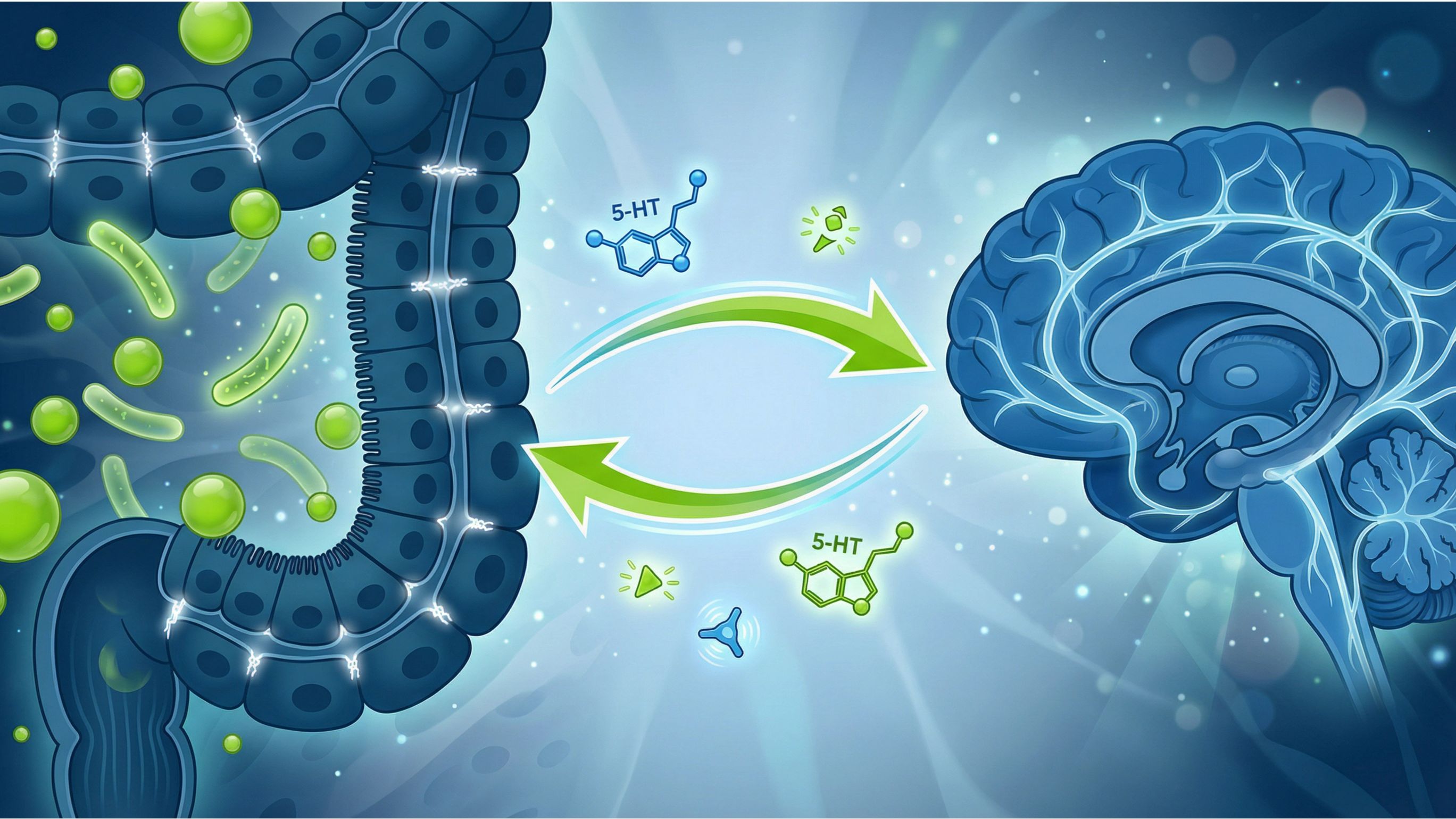
Your gut health and mental health are not separate problems — they're the same one.
If you've been doing everything "right" for your mental health — therapy, meditation, maybe even medication — and still feel like something just won't shift, this read is for you.
In this article, you'll learn why gut health and mental health are biologically linked through a bidirectional communication network, how gut bacteria directly influence the neurotransmitters behind your mood, and what happens when your gut barrier breaks down.
More importantly, you'll learn what you can actually do about it.
There's also something I share midway through that most people in this conversation haven't heard yet — and it changes the whole picture. Stick around for it.
Key Takeaways
- The gut-brain axis is a bidirectional communication system — gut health and mental health directly influence each other through the vagus nerve, immune signaling, and neurotransmitter precursor pathways.⁷
- Over 90% of the body's serotonin is produced in the gut and gut dysbiosis disrupts the upstream chemistry your brain depends on for emotional stability.²,³,⁴
- Gut barrier integrity is central to the mental health equation. A compromised gut lining allows inflammatory molecules like LPS into the bloodstream, triggering the neuroinflammation associated with depression and anxiety.⁵,⁷,⁸
- Food sensitivities and leaky gut testing are critical steps in any real gut-brain healing protocol. Without knowing what's compromising your gut barrier, any approach is incomplete.
- The oral microbiome feeds directly into the gut every day. Oral pathogens can drive systemic inflammation and neurological symptoms,¹² making oral microbiome testing a relevant piece of the picture for many people.
- Testing first, not guessing — personalized protocols based on your actual gut barrier markers, food sensitivity results, and microbial data produce far better outcomes than generic approaches.
Want to Go Deeper on the Gut-Brain Connection?
Watch the Interconnected series
Leading functional medicine experts reveal the exact mechanisms behind how your gut shapes your mental health. Limited-time free viewing.
Start Watching →The thing nobody tells you about your mood
Here's the thing I've been telling patients for decades that still surprises almost everyone: your gut has its own nervous system.
It's called the enteric nervous system, and it contains between 200 and 600 million neurons — comparable in scale to the neurons in the spinal cord.¹,⁹
We call it the "second brain" for a reason.
And here's where it gets really interesting:
Over 90% of the body's serotonin — one of the key neurotransmitters involved in mood, anxiety, and emotional regulation — is produced in your gut, not in your brain.²,³,⁴
Now, I want to be precise here because this point is often oversimplified.
Gut-derived serotonin doesn't simply cross the blood-brain barrier and lift your mood directly. What it does is far more nuanced — and frankly, more important.
Your gut microbiome regulates the availability of tryptophan, the amino acid precursor your brain needs to make its own serotonin and melatonin.³
It also communicates with your brain through the vagus nerve, immune signaling, and short-chain fatty acid production.⁷,¹⁰
When the gut ecosystem is out of balance, this entire upstream chemistry goes sideways — and your mental health pays the price.⁷,⁸
This is the gut-brain connection, and it's why the fight for your mental health may need to start in your gut.
What's Disrupting Your Gut-Brain Chemistry?
Find out with comprehensive testing
Gut barrier assessment, food sensitivity panels, and personalized protocols based on YOUR results.
Explore Your Testing Options →Why gut bacteria affect mental health more than we realized
The microbiome-gut-brain axis is now one of the most actively researched areas in medicine.
Peer-reviewed studies consistently show that people with depression and anxiety have measurably different gut microbiome compositions compared to healthy controls.⁴
The key mechanisms are worth understanding because they explain why so many people feel stuck:
Inflammation as a mood disruptor.
When the gut barrier becomes compromised — what we call intestinal permeability or leaky gut — inflammatory molecules called lipopolysaccharides (LPS) from gram-negative bacteria can cross into the bloodstream.⁵,⁸
These LPS molecules trigger a widespread inflammatory immune response.
Pro-inflammatory cytokines like IL-6, IL-1β, and TNF-α then travel to the brain, activating neuroinflammation that has been directly associated with depression onset.⁵
I've seen this play out in my own patients more times than I can count.
The tryptophan-kynurenine pathway.
Under chronic inflammation, tryptophan gets diverted away from serotonin production and pushed down a different metabolic route — the kynurenine pathway.³
This overactivation produces neurotoxic compounds, reduces neuroprotective ones, and depletes mood-balancing neurotransmitters including GABA and dopamine.³
In plain terms: your body is under stress, and your brain chemistry follows.
🔄 The Gut-Brain Axis Communication Pathways
Three highways connecting your gut and brain
Vagus Nerve
Direct neural connection carrying signals in both directions. Influences GABA receptors in the brain, affecting anxiety levels.
Immune Signaling
Inflammatory cytokines (IL-6, IL-1β, TNF-α) travel from gut to brain when barrier is compromised, triggering neuroinflammation.
Neurotransmitter Production
Gut bacteria regulate tryptophan availability, the amino acid your brain needs to produce serotonin and melatonin.
200-600M
Neurons in your "second brain" (enteric nervous system)
The vagus nerve as a direct line.
The vagus nerve is the main communication highway between your gut and your brain, carrying signals in both directions.
Specific strains of gut bacteria can actually influence GABA receptor expression in the brain via the vagus nerve — which directly affects anxiety levels.⁶
Research also shows that vagus nerve stimulation has demonstrated therapeutic potential for both anxiety and gut disorders,¹¹ which is why vagus nerve exercises and vagus nerve stimulation are showing such promising results for both gut symptoms and mood.
The two systems are literally wired together.
If you've been wondering why your anxiety spiked after a round of antibiotics, or why your mood tanks when your digestion is off, this is why.
Gut bacteria affect mental health at a fundamental biochemical level — not just loosely, but through specific, measurable pathways.
Your Gut May Be Running Your Mood
Testing Can Prove It
If your gut has never been part of your mental health conversation, you're working with an incomplete picture. Stop guessing. Start knowing.
Discover Your Testing Options →Can gut health cause depression? Here's what the research says
This is one of the most common questions I get, and the honest answer is: the relationship runs in both directions.⁷
Gut dysbiosis — an imbalance in the microbial communities of your gut — can contribute to depressive symptoms through the inflammatory and neurochemical pathways above.⁵,⁸
But depression and chronic stress also change gut motility, permeability, and microbial composition, which then worsens the gut environment further.⁷
It becomes a self-reinforcing cycle that's genuinely hard to break if you're only addressing one side of it.
What I see in my practice is a lot of people who've been working hard on their mental health — doing the therapy, journaling, trying to manage stress — but nobody has ever looked at what's happening in the gut.
And when we do look, we almost always find something worth addressing.
You can read more about this specific connection in this post on gut testing for anxiety and how the gut-brain connection controls your mood.
What gut bacteria produce serotonin?
Several strains are directly involved in serotonin biosynthesis or its precursors, including Lactobacillus, Bifidobacterium, Enterococcus, and spore-forming Clostridia species.²
Dysbiosis — an overgrowth of pathogenic bacteria or a loss of these beneficial strains — disrupts this production.
Can fixing your gut help anxiety?
Based on both the emerging research and what I've watched happen with patients who've committed to gut healing protocols, yes — often significantly.
But the key word is fixing. Not guessing. Not throwing random probiotics at the problem and hoping for the best.
The gut barrier — the part of this story most people are missing
If I had to point to one thing that sits at the center of both gut health and mental health disruption, it's the integrity of the gut barrier.
Your gut lining is designed to be selectively permeable — allowing nutrients in while keeping bacteria, undigested food particles, and toxins out.
The proteins zonulin and occludin act as the gatekeepers of this barrier. When they become dysregulated — through stress, processed food, antibiotics, alcohol, or chronic infection — the tight junctions between intestinal cells loosen.
That's when things go wrong systemically.
🧱 The Leaky Gut Barrier Breakdown
What happens when your gut's gatekeepers fail
Healthy Gut Barrier
🔒 Tight Junctions Intact: Zonulin and occludin proteins properly regulate what enters your bloodstream
🦠 Bacteria Blocked: Pathogens and LPS stay safely in gut lumen
✨ Selective Permeability: Nutrients pass through, toxins stay out
Compromised Barrier (Leaky Gut)
🔓 Loose Junctions: Stress, processed foods, food sensitivities, antibiotics dysregulate gatekeepers
💉 LPS Enters Bloodstream: Bacterial toxins trigger widespread inflammation
🧠 Neuroinflammation Begins: Cytokines travel to brain, linked to depression and anxiety
🎯 Testing zonulin and occludin markers reveals if your gut barrier is compromised — the missing piece most mental health protocols overlook.
The LPS-driven inflammation we mentioned earlier? It only becomes a problem when the gut barrier lets LPS through.
The neuroinflammation that drives depression and anxiety? It's downstream of a compromised gut lining.⁵,⁸
If you've been struggling with brain fog and anxiety, or persistent brain fog despite good sleep, a leaky gut barrier is one of the first places worth investigating.
There's also a lesser-known oral connection here.
The Oral-Gut-Brain Connection
Your mouth is the gateway that feeds your gut — and brain — every day
Step 1: Oral Microbiome
150 billion to 1 trillion bacteria travel from mouth to gut daily through swallowing.
Step 2: Gut Disruption
Oral pathogens like P. gingivalis disrupt gut microbial balance and compromise barrier integrity.
Step 3: Systemic Inflammation
Oral bacteria enter bloodstream through compromised gum tissue, triggering body-wide inflammatory response.
Step 4: Neurological Impact
Inflammation crosses blood-brain barrier, contributing to brain fog, anxiety, and neurodegenerative conditions.
👄 Oral microbiome testing identifies which bacteria you're harboring — so you can address the source before it reaches your gut and brain.
Every day, roughly 150 billion to 1 trillion bacteria travel from your mouth into your gut and bloodstream.
When oral pathogens like Porphyromonas gingivalis are present, they can disrupt gut microbial balance, trigger systemic inflammation, and contribute to neurological symptoms through multiple pathways including the gut-brain axis.¹²
Brain fog causes often begin in the mouth before they ever show up in the gut.
The Oral-Gut-Brain Axis Explained
Gateway to Health Series – Free 10-Day Screening
Discover how your oral microbiome directly impacts gut health and mental wellness. Expert-led documentary series covering the connections conventional medicine misses.
Watch Free Now →What you can actually do about it
I want to be direct here: if your gut health is affecting your mental health, working on stress management and sleep hygiene alone won't be enough.
Those things matter, but they're working downstream of a system that may need more targeted support.
Here's where I'd focus:
Test the gut barrier, not just the microbiome.
Most standard tests miss the structural integrity of the gut lining entirely.
Markers like zonulin, occludin, and LPS tell you whether bacterial toxins are actually crossing into your bloodstream and driving inflammation.
This is what separates a targeted gut healing protocol from a generalized "eat more fiber" recommendation.
Learn about comprehensive gut testing options here.
Address food sensitivities.
Unidentified food sensitivities create low-grade, chronic inflammation that quietly fuels both gut permeability and mood disruption.
Many people are reacting to foods they eat daily without ever making the connection.
A comprehensive IgG + C3d food sensitivity panel is one of the most valuable tools I've seen for breaking this cycle.
Our comprehensive gut test also includes 22 food sensitivities testing that can be upgraded to 176 foods.
Support the vagus nerve.
Given its central role in gut-brain communication, directly supporting vagal tone is worth considering as part of your mental wellness approach.
The VIBE vagus nerve stimulator device offers non-invasive vagal stimulation that some of our community members have found genuinely helpful alongside gut healing protocols.
Don't overlook the oral microbiome.
If you have any history of gum disease, bleeding gums, or chronic dental infections, getting your oral microbiome tested is a logical step.
The Orobiome test identifies which oral bacteria you're harboring so you can take targeted action — rather than disrupting a healthy oral ecosystem unnecessarily.
Ready to Stop Guessing and Start Knowing?
Get Clarity With Comprehensive Gut Testing
If you recognize yourself in the cycle of gut symptoms and mood struggles, the next step is clarity. Every protocol starts with YOUR individual results, not a one-size-fits-all guess.
Explore Testing Options →
Sources
- The enteric nervous system and gastrointestinal innervation: integrated local and central control. Advances in Experimental Medicine and Biology. 2014.
- Indigenous bacteria from the gut microbiota regulate host serotonin biosynthesis. Cell. 2015.
- Microorganisms' footprint in neurodegenerative diseases. Frontiers in Cellular Neuroscience. 2018.
- The microbiota-gut-brain axis in psychiatric disorders. International Journal of Molecular Sciences. 2022.
- The microbiota-gut-brain axis in depression: the potential pathophysiological mechanisms and microbiota combined antidepression effect. Nutrients. 2022.
- Ingestion of Lactobacillus strain regulates emotional behavior and central GABA receptor expression in a mouse via the vagus nerve. PNAS. 2011.
- The microbiota-gut-brain axis: from motility to mood. Gastroenterology. 2021.
- Brain-gut-microbiota axis and mental health. Psychosomatic Medicine. 2017.
- The enteric nervous system and neurogastroenterology. Nature Reviews Gastroenterology & Hepatology. 2012.
- Vagal pathways for microbiome-brain-gut axis communication. Advances in Experimental Medicine and Biology. 2014.
- Vagus nerve stimulation at the interface of brain-gut interactions. Cold Spring Harbor Perspectives in Medicine. 2019.
- Porphyromonas gingivalis in Alzheimer's disease brains: evidence for disease causation and treatment with small-molecule inhibitors. Science Advances. 2019.