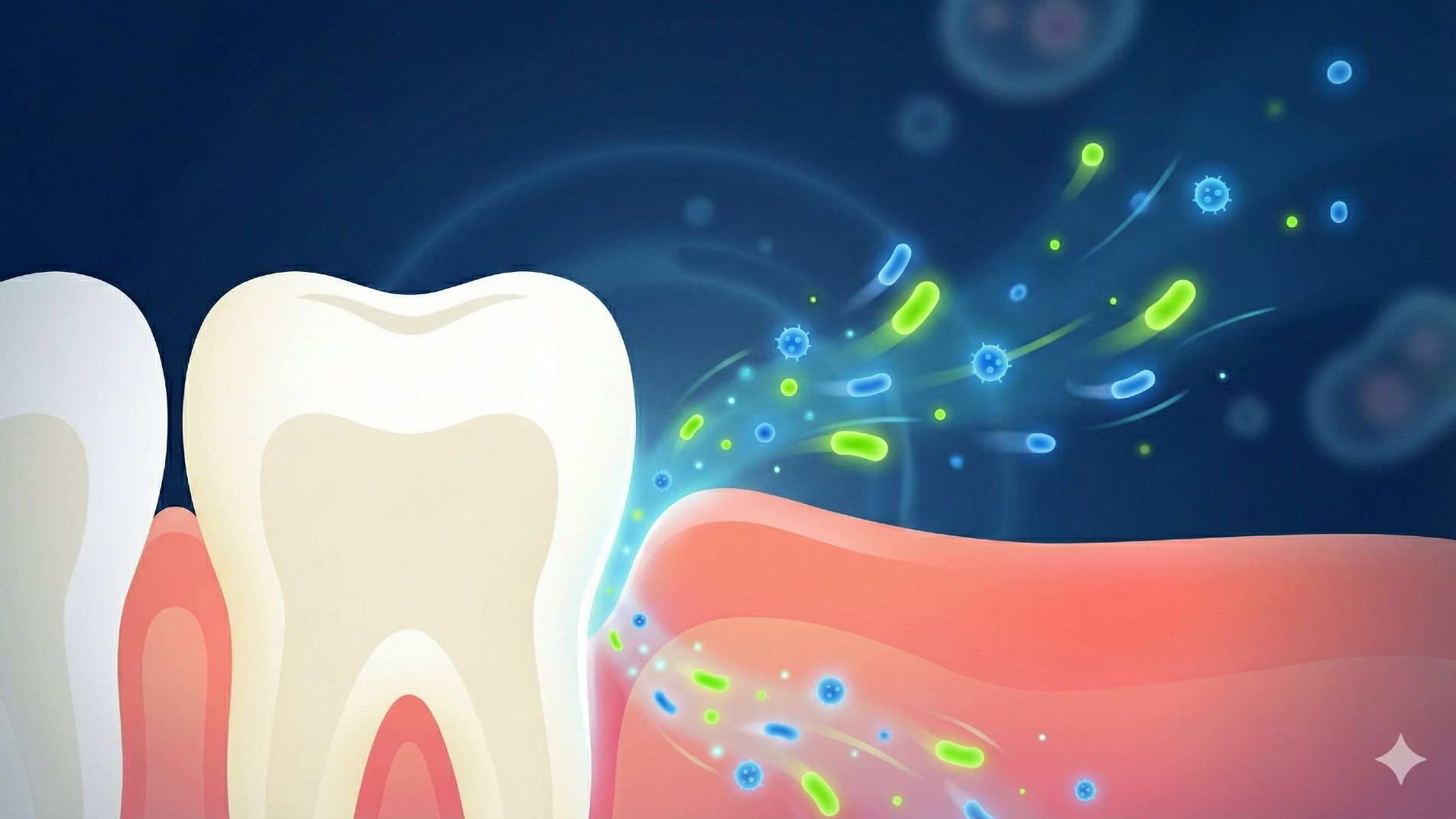
Leaky mouth syndrome — how oral bacteria trigger inflammation throughout your body
You've heard about leaky gut. But what about leaky mouth syndrome?
Every day, you swallow approximately 100 billion bacteria from your mouth.¹
For most people, this isn't a problem — your oral microbiome keeps harmful bacteria in check.
But when your gums become inflamed and start bleeding, those protective barriers break down.
Suddenly, pathogenic bacteria have direct access to your bloodstream, traveling to your heart, brain, gut, and beyond.
This is leaky mouth syndrome, and it may be the hidden trigger behind your chronic health struggles.
In this article, you'll discover:
- How bleeding gums create pathways for bacteria to enter your bloodstream
- The scientific connection between oral inflammation and heart disease, Alzheimer's, and gut disorders
- Why conventional dentistry misses this root cause
- A testing-based approach to restore oral health and reduce systemic inflammation
If you've been struggling with unexplained inflammation, brain fog, digestive issues, or cardiovascular concerns that doctors can't seem to fix, the answers may be hiding in your mouth.
Keep reading — what you learn could change everything about how you approach your health.
Key Takeaways
- Leaky mouth syndrome occurs when inflamed, bleeding gums allow pathogenic oral bacteria to enter the bloodstream and trigger systemic inflammation¹,²
- You swallow approximately 100 billion bacteria daily — when oral dysbiosis occurs, harmful bacteria continuously seed your gut microbiome¹,³
- Porphyromonas gingivalis, a key oral pathogen, has been found in atherosclerotic plaques, Alzheimer's brain tissue, and linked to multiple chronic diseases⁶,⁷,⁸
- People with periodontitis have a 1.27-fold higher risk of atherosclerosis and increased risk of heart attack, stroke, and cognitive decline⁶,⁷,⁸
- The mouth-gut axis means oral bacteria directly influence digestive health, potentially causing or worsening leaky gut²,¹⁰
- Bleeding gums aren't normal — they signal barrier breakdown and increased systemic inflammatory burden¹,²,⁵
- Oral microbiome testing reveals which specific bacteria are driving inflammation, allowing you to get personalized treatment protocols.
Discover What's Living in Your Mouth
Comprehensive oral microbiome testing reveals which bacteria are driving your inflammation
Test Your Oral Microbiome→What Leaky Mouth Syndrome Really Means
You're probably familiar with leaky gut — that state where your intestinal lining becomes compromised, allowing bacteria and toxins to escape into your bloodstream.
Leaky mouth syndrome works the same way, but it happens first.
Your gums form a critical barrier between the 700+ species of bacteria living in your mouth and your bloodstream.³
When this barrier is healthy, beneficial bacteria dominate and harmful ones stay contained.
But when gum inflammation sets in — often marked by bleeding when you brush — this protective seal breaks down.
The gingival sulcus, that tiny space between your tooth and gum, becomes a gateway.
The junctional epithelium that normally attaches tightly to your tooth surface weakens and detaches.
These compromised tissues create microscopic portals that allow pathogenic bacteria like Porphyromonas gingivalis, Prevotella intermedia, and Treponema denticola to slip through.²
The Leaky Mouth Pathway
Once in your bloodstream, these bacteria don't just disappear.
They circulate throughout your body, colonizing distant organs and triggering inflammatory responses wherever they land.
The Inflammation Cascade Nobody Talks About
When oral bacteria breach your gum barrier, they set off a domino effect.
Your immune system recognizes these invaders and responds with inflammatory mediators — the same molecules implicated in heart disease, diabetes, and neurodegenerative conditions.⁴
Periodontitis has been established as a significant source of chronic low-grade inflammation in the body.¹¹
This isn't the acute inflammation you get from a splinter — that's protective and resolves quickly.
This is the persistent, smoldering inflammation that damages tissues over decades.
And the research connecting oral bacteria to systemic disease is overwhelming:
Heart Disease
Patients with periodontitis show a 1.27-fold higher prevalence of atherosclerosis.⁶
P. gingivalis has been detected in atherosclerotic plaques and thrombus specimens from people who suffered heart attacks.⁷
This isn't just correlation — pathological analyses confirm the bacteria's presence in the exact locations where cardiovascular damage occurs.
Alzheimer's Disease
In groundbreaking research published in Science Advances, scientists identified P. gingivalis and its toxic proteases (gingipains) in the brain tissue of Alzheimer's patients, with levels correlating to tau and ubiquitin pathology.⁹
When mice were orally infected with P. gingivalis, the bacteria colonized their brains and increased production of amyloid plaques.
Diabetes
The relationship runs both ways.
Periodontal inflammation worsens blood sugar control, while diabetes increases susceptibility to gum disease.¹⁰
The chronic inflammatory burden from your mouth directly interferes with insulin sensitivity.¹⁰
Oral-Systemic Disease Connections
How oral bacteria trigger chronic disease throughout your body
This is how gum disease affects the heart and other organs — not through mystery mechanisms, but via direct bacterial invasion and sustained inflammatory signaling.
Your Mouth-Gut Highway
Your digestive tract doesn't start in your stomach. It starts in your mouth.
Every time you swallow, oral bacteria travel down to your gut.¹,²
In healthy individuals with balanced oral microbiomes, this constant seeding actually supports digestive health.
But when oral dysbiosis takes hold — when harmful bacteria outnumber beneficial ones — you're essentially swallowing pathogens all day long.
Recent research demonstrates that oral bacteria found in the gut are almost universally associated with inflammation.²,⁴,⁵,¹¹,¹³
When oral pathogenic bacteria colonize your intestines, they disrupt the delicate balance of your gut microbiome, leading to gut dysbiosis.⁵,¹¹
This creates a vicious cycle: bacteria from the gut travel through your bloodstream, oral bacteria continuously reseed dysbiosis in your gut, and both contribute to a state called "leaky gut syndrome."²,⁵,¹¹
When you have both a leaky mouth and leaky gut, you're experiencing a double assault.
Inflammatory bacteria escape from two major barrier sites, amplifying the immune response and inflammatory burden throughout your entire body.
Is Your Gut Being Seeded by Oral Pathogens?
Comprehensive gut testing reveals food sensitivities, barrier function, and dysbiosis caused by the oral-gut connection
Discover Your Gut Health→The Warning Signs Your Body Sends
Can bleeding gums cause health problems beyond your mouth? Absolutely.
Oral symptoms:
- Bleeding gums, even slightly pink saliva when brushing
- Persistent bad breath that doesn't improve with brushing
- Receding gums or teeth that feel loose
- Chronic metallic taste
Systemic symptoms that may trace back to your mouth:
- Unexplained fatigue and low energy
- Brain fog and difficulty concentrating
- Joint pain and morning stiffness
- Digestive problems despite dietary changes
- Frequent infections or slow wound healing
One of my recent patients, struggling with rheumatoid arthritis for years, had tried everything — elimination diets, supplements, medications.
Her doctors never connected her severely inflamed gums to her joint pain.
When we tested her oral microbiome and discovered significant overgrowth of inflammatory bacteria, we implemented a targeted protocol.
Within six weeks of addressing her oral health, her joint inflammation markers dropped measurably. Her rheumatologist was stunned.
This isn't unusual.
The connection between periodontal disease and autoimmune inflammation is well-established in research,⁴,¹²,¹⁶ yet rarely addressed in clinical practice.
Why Your Regular Dental Cleaning Isn't Enough
Here's the fundamental issue conventional dentistry misses:
Treating your mouth as isolated from your body ignores decades of research showing how oral bacteria drive systemic disease.
Conventional dentistry operates on a "drill and fill" model.
You come in twice a year, get your teeth cleaned, maybe get a cavity filled, and you're sent on your way.
Nobody tests your oral microbiome. Nobody evaluates which specific bacteria are proliferating.
Nobody connects your bleeding gums to your diagnosis of prediabetes or your family history of heart disease.
This approach treats symptoms, not root causes.
Functional oral health takes a different path.
We recognize that your mouth is an ecosystem, not just a collection of teeth.
When that ecosystem falls out of balance — when pathogenic bacteria overgrow and protective species decline — simply scraping away plaque isn't enough.
You need to know:
- Which specific pathogenic bacteria are present
- How severely your oral microbiome is disrupted
- Whether oral bacteria are already in your bloodstream
- What targeted interventions will restore balance
That's where oral microbiome testing comes in.
Instead of guessing, we measure.
We identify the exact bacterial species driving inflammation in your unique oral environment, then create personalized protocols to address them.
The Path Forward: Healing Leaky Mouth Syndrome
Restoring oral health — and by extension, systemic health — requires a strategic, science-based approach.
Step 1: Test Your Oral Microbiome
You can't fix what you can't measure.
Comprehensive oral microbiome analysis reveals which pathogenic bacteria have colonized your mouth and identifies protective species that may be depleted.
This isn't guesswork — it's precision medicine for your mouth.
You'll receive detailed results reviewed by a licensed oral health professional who can interpret what your specific bacterial profile means for your health.
Explore the Orobiome Test
Comprehensive oral microbiome analysis with licensed professional review and personalized protocols based on your results
Explore the Test→Step 2: Remove Inflammatory Triggers
Once you know what you're dealing with, you can take targeted action.
This might include:
- antimicrobial protocols specific to your bacterial profile,
- eliminating dietary sugars that feed pathogenic bacteria,
- addressing dry mouth (a major risk factor for oral dysbiosis),
- and ensuring proper oral hygiene tailored to your needs.
Step 3: Restore Microbial Balance
Healing isn't just about killing bad bacteria — it's about repopulating good ones.
Targeted oral probiotics containing specific strains, pH-balancing strategies, and nutritional support with CoQ10, vitamin C, vitamin K2, and omega-3 fatty acids all support oral barrier integrity and beneficial bacterial growth.
Step 4: Repair Barrier Function
If you have advanced periodontal disease, you may need specialized professional intervention — scaling and root planing, laser therapy, or other restorative techniques.
Modern dentistry offers remarkable tools for tissue healing, and they work best when combined with microbiome restoration.
Throughout this process, stress management matters more than you might think.
Chronic stress elevates cortisol, which can damage both oral and intestinal barriers, making you more susceptible to bacterial translocation.¹⁴,¹⁵
Ready to Heal From the Inside Out?
Leaky mouth syndrome isn't just about your teeth.
It's also about your heart, your brain, your gut, and your overall inflammatory burden.
The good news? This is a modifiable risk factor.
You have the power to test, to know, and to act.
Understanding the connection between your oral health and systemic inflammation is the first step.
The second step is discovering exactly what's happening in your unique oral microbiome.
We've partnered with the leading laboratory in oral microbiome analysis to bring you comprehensive testing that reveals your bacterial profile with precision.
You'll receive detailed results reviewed by a licensed oral health professional, along with a personalized protocol designed for your specific needs.
Get your comprehensive oral microbiome test →
Want to learn more about the oral-systemic connection before you test?
Watch the complete Gateway to Health documentary series free for 10 days.
You'll discover cutting-edge research on how your mouth influences every system in your body — and what you can do about it.
Watch Gateway to Health free for 10 days →
Your mouth is trying to tell you something.
Bleeding gums aren't normal. Chronic bad breath isn't just embarrassing.
These are signals that your oral barrier is compromised and inflammation is spreading throughout your body.
Listen to those signals. Test. Know. Act.
Related Articles:
- How Oral Health and Chronic Disease Are Connected
- Brain Fog Causes Start in Your Mouth and Travel to Your Gut
- Bleeding Gums: What It Means for Your Brain & Heart Health
- Gut Inflammation Causes Hiding in Plain Sight

Sources
- Comparative analysis of bacterial profiles in unstimulated and stimulated saliva samples. Journal of Oral Microbiology. 2016.
- Leaky Gum: The Revisited Origin of Systemic Diseases. Cells. 2022.
- Oral microbiome: Unveiling the fundamentals. Journal of Oral and Maxillofacial Pathology. 2019.
- Periodontitis: from microbial immune subversion to systemic inflammation. Nature Reviews Immunology. 2015.
- The “Gum–Gut” Axis in Inflammatory Bowel Diseases: A Hypothesis-Driven Review of Associations and Advances. Frontiers in Immunology. 2021.
- Periodontal Disease and Other Adverse Health Outcomes Share Risk Factors, including Dietary Factors and Vitamin D Status. Nutrients. 2023.
- Porphyromonas gingivalis aggravates atherosclerotic plaque instability by promoting lipid-laden macrophage necroptosis. Signal Transduction and Targeted Therapy. 2025.
- Detection of periodontal bacteria in thrombi of patients with acute myocardial infarction by polymerase chain reaction. American Heart Journal. 2012.
- Porphyromonas gingivalis in Alzheimer's disease brains: Evidence for disease causation and treatment with small-molecule inhibitors. Science Advances. 2019.
- Diabetes as a potential risk for periodontitis: association studies. Periodontology 2000. 2020.
- The intermucosal connection between the mouth and gut in commensal pathobiont-driven colitis. Cell. 2020.
- Periodontitis, Low-Grade Inflammation and Systemic Health: A Scoping Review. Medicina. 2020.
- Local and systemic mechanisms linking periodontal disease and inflammatory comorbidities. Nature Reviews Immunology. 2021.
- Role of Corticotropin-releasing Factor in Gastrointestinal Permeability. Journal of Neurogastroenterology and Motility. 2015.
- Psychosocial stress-induced intestinal permeability in healthy humans: What is the evidence? Neurogastroenterology & Motility. 2023.
- Role of Autoimmune Responses in Periodontal Disease. Autoimmune Diseases. 2014.