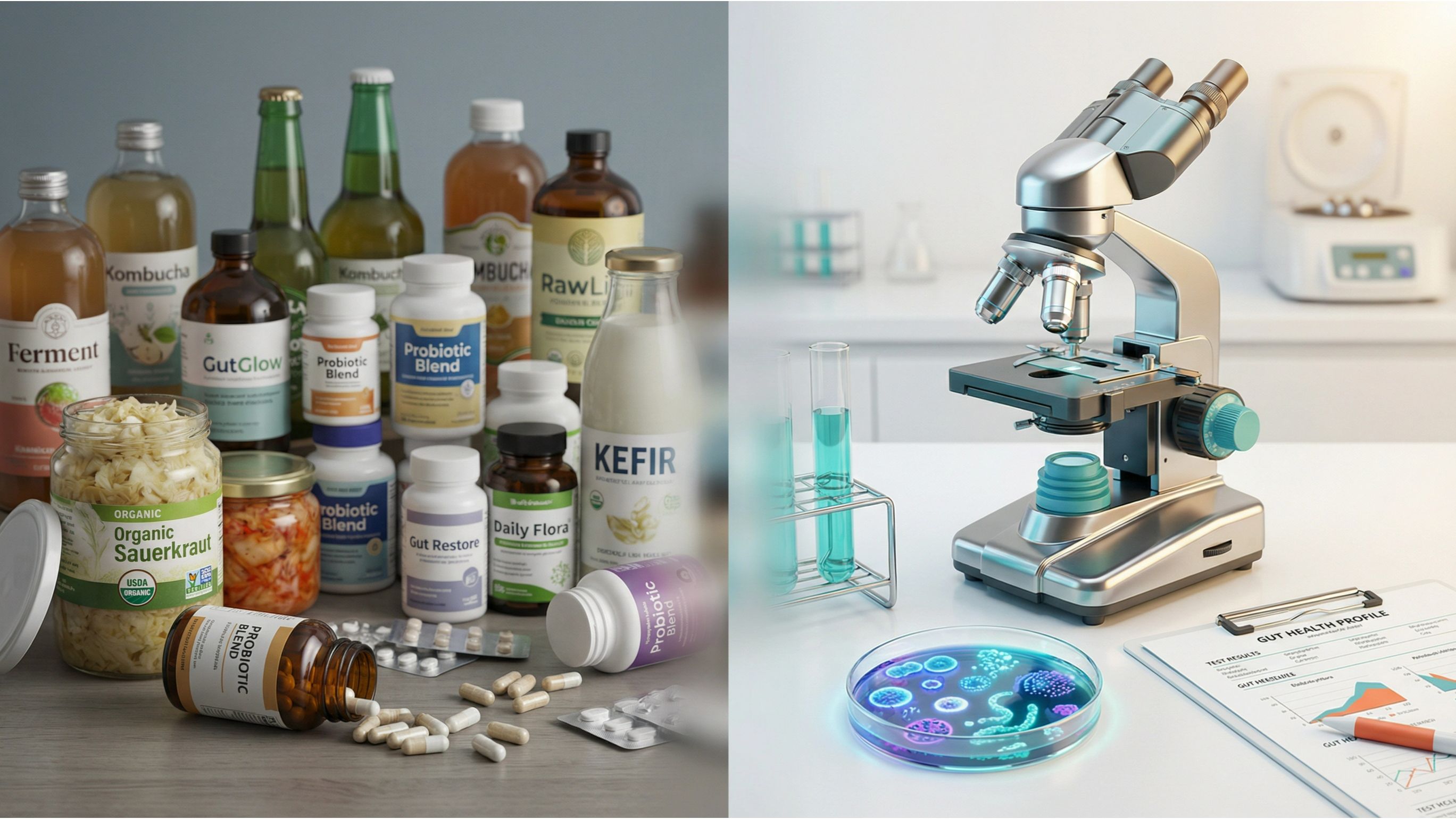
Probiotic foods for gut health only work when you know which strains your body actually needs
You've spent hundreds on kombucha, sauerkraut, and probiotic supplements. You've added fermented foods to every meal.
Yet your gut still feels off, your energy hasn't improved, and you're wondering why everyone else seems to get results from probiotic foods for gut health while you're stuck in the same place.
Here's what I've learned after decades in clinical practice: the problem isn't that probiotic foods don't work — it's that you're consuming strains your gut doesn't need while missing the ones it's actually crying out for.
In this article, I'll show you why a food-first approach only delivers results when it's personalized to your unique bacterial imbalances, how the oral-gut connection affects which probiotics actually colonize your digestive system, and the specific testing that reveals exactly which strains will move the needle for your health.
You'll discover why generic probiotic advice fails most people and what actually works instead.
This isn't another generic list of fermented foods.
Keep reading to discover the precision approach that's helping my patients finally see the gut health results they've been chasing for years.
Key Takeaways
- Different probiotic strains serve distinct functions — Lactobacillus and Bifidobacterium species alone include hundreds of variations, each affecting your gut differently.
- Your oral microbiome directly influences gut colonization, making oral health a critical factor in whether probiotic foods actually benefit your digestive system.
- Food sensitivities and gut permeability determine which probiotic-rich foods help versus harm your specific system.
- Fermented foods provide benefits only when they contain strains that address your unique bacterial deficiencies or overgrowths.
- Comprehensive gut microbiome testing reveals your specific imbalances, transforming probiotic foods from guesswork into targeted therapy.
- Supplements complement food sources when testing identifies precise strain deficiencies that diet alone can't address.
- The oral-gut axis means neglecting dental health undermines even the best probiotic food strategies.
Why Most People Waste Money on the Wrong Probiotic Foods
I can't tell you how many patients walk into my practice having tried every probiotic food on the market.
Kimchi for breakfast, kombucha with lunch, kefir before bed.
They've spent thousands of dollars and months of effort, yet their symptoms persist.
The issue? They're following generic advice that treats all gut problems — and all probiotic strains — as if they're identical.
Research confirms what I see clinically: probiotic effectiveness is highly strain-specific.¹
A Lactobacillus strain that reduces inflammation for one person might do nothing for another, or even worsen their symptoms.
The same goes for Bifidobacterium species — some support immune function, others focus on metabolic health, and still others specialize in gut barrier integrity.²
Think about it this way: if you had an iron deficiency, you wouldn't just eat "more nutrients." You'd specifically increase iron-rich foods.
Your gut microbiome works the same way. You need the specific bacterial strains your system is missing — not just more bacteria in general.
This is where microbiome testing transforms the conversation from guesswork into precision.
The Strain Specificity Problem Nobody Talks About
When you look at a bottle of kombucha or a jar of sauerkraut, you're not just getting "probiotics."
You're getting specific bacterial strains, each with distinct genetic profiles and functions.
Let me break this down with some examples from the research:
Lactobacillus acidophilus has been shown to support cholesterol management and immune function, but it works differently than Lactobacillus plantarum, which excels at supporting the gut barrier and reducing inflammation.³
Meanwhile, Bifidobacterium longum specializes in immune modulation and may help with anxiety and stress responses, while Bifidobacterium lactis focuses more on digestive function and regularity.⁴
The science is clear: different strains activate different immune cells, produce different metabolites, and address different health challenges.⁵
Using probiotics without knowing which strains you need is like throwing darts blindfolded — you might hit the target eventually, but you'll waste a lot of time and money in the process.
This is why I'm so passionate about testing.
When we can see exactly which bacterial families are depleted or overgrown in your gut, we can recommend the specific probiotic foods and supplements that will actually make a difference.
Your Mouth Determines Whether Probiotic Foods Actually Work
Here's something that surprises most people: your oral microbiome plays a massive role in determining whether probiotic foods successfully colonize your gut.
The oral cavity and gut are directly connected through the gastrointestinal tract.
Every time you swallow — which happens hundreds of times per day — you're sending oral bacteria into your digestive system.
Research shows that oral bacteria frequently translocate to the gut, where they can either support or disrupt your intestinal microbiome.⁶
When your oral microbiome is imbalanced — often due to gum disease, poor dental hygiene, or chronic inflammation — pathogenic oral bacteria migrate to your gut and compete with the beneficial probiotic strains you're trying to establish through fermented foods.⁷
I've seen this pattern repeatedly in practice. A patient consumes all the right probiotic foods, but their gut health doesn't improve because oral dysbiosis keeps reseeding their intestines with inflammatory bacteria.
It's like trying to fill a bucket with holes in the bottom.
The oral-gut axis works both ways, too.
Studies show that gut inflammation can worsen oral health, creating a vicious cycle that undermines both systems.⁸
This is why we take oral microbiome balance seriously when addressing digestive health.
How Food Sensitivities Sabotage Your Probiotic Strategy
Here's another critical factor that conventional probiotic advice misses: food sensitivities directly impact which probiotic foods help versus harm your system.
Let's say you're dairy-sensitive and you start consuming kefir daily because you've heard it's great for gut health.
For someone without dairy sensitivity, kefir can be excellent — it contains beneficial Lactobacillus and Bifidobacterium strains.
But for you, it triggers an inflammatory response that worsens gut permeability and actually damages the intestinal lining you're trying to heal.
Same goes for fermented vegetables if you have histamine intolerance, or kombucha if you're sensitive to yeast overgrowth.
The probiotic content becomes irrelevant when the food vehicle itself causes inflammation in your system.
This is why comprehensive testing that includes food sensitivity panels — not just generic probiotic recommendations — is crucial.
When we identify your specific trigger foods, we can steer you toward probiotic sources that support your gut rather than inflaming it.
For some people, that means focusing on fermented vegetables like sauerkraut and kimchi.
For others, it means dairy-based options like yogurt or kefir.
And for some, it means temporarily avoiding fermented foods altogether while we heal gut permeability first.
Understanding these connections helps explain why the same probiotic food that transforms one person's gut health does nothing — or causes problems — for someone else.
Your body's unique inflammatory responses matter just as much as the bacterial strains you're consuming.
The Truth About Probiotic Foods Versus Supplements
I get asked this question constantly:
"Should I focus on probiotic foods or just take supplements?"
My answer: both, but in the right sequence and for the right reasons.
Probiotic-rich foods should be your foundation.
Traditional fermented foods like kimchi, sauerkraut, and miso provide not just live bacteria but also the prebiotic fibers and polyphenols that feed beneficial gut bacteria.
They're whole foods that support your microbiome in multiple ways simultaneously.
But here's where supplements become essential: when testing reveals specific strain deficiencies or therapeutic needs that food sources can't adequately address.
If your gut microbiome analysis shows you're critically low in Bifidobacterium species, or you need targeted support for immune function or inflammation, therapeutic-dose supplements containing researched strains become necessary.
Think of it this way: fermented foods maintain and support a healthy microbiome. Supplements rebuild and repair a damaged one.
Both have their place, but supplements are most effective when they're addressing documented imbalances rather than compensating for generic "maybe this will help" approaches.
This is another area where testing changes everything.
Instead of spending hundreds on random probiotic supplements hoping something works, you invest in the specific strains science shows will benefit your unique bacterial profile.
What Gut Testing Actually Reveals
When I mention "gut testing," I'm not talking about the basic panels that most conventional doctors run. I'm talking about comprehensive analysis that examines:
Bacterial diversity and specific strain levels – which beneficial species are you missing, and which pathogenic ones have overgrown?
This goes far beyond just "good bacteria versus bad bacteria" and reveals the specific imbalances driving your symptoms.⁹
Gut permeability markers – is your intestinal barrier compromised?
Markers like zonulin, occludin, and LPS (lipopolysaccharides) show whether you have a leaky gut that's allowing undigested food particles and bacteria into your bloodstream, triggering systemic inflammation.
Food sensitivity patterns – not just the common suspects like dairy and gluten, but comprehensive panels testing 22 - 176 foods that might be triggering immune responses and preventing gut healing.
This level of detail transforms your approach from "try more probiotics and hope for the best" to "here are the exact strains your system needs, the foods that are inflaming your gut, and the markers showing whether your interventions are actually working."
I've seen patients who've struggled with gut issues for years finally get answers through comprehensive testing.
One woman discovered that despite eating fermented foods daily, she had severe dysbiosis with pathogenic bacteria overgrowth and multiple food sensitivities that were preventing any probiotic benefit.
Within three months of following a personalized protocol based on her test results — removing her trigger foods and adding specific probiotic strains she was deficient in — her symptoms resolved completely.
That's the power of precision over guesswork. You can learn more about the benefits of at-home microbiome testing and how it compares to generic approaches.
The Complete Approach That Actually Works
So what does a data-driven, personalized approach to probiotic foods for gut health actually look like?
First, test your gut and oral microbiomes to identify specific imbalances, food sensitivities, and permeability issues. This gives you the roadmap instead of wandering in the dark.
Second, address oral health if testing reveals dysbiosis.
No amount of probiotic foods will overcome constant reseeding of pathogenic bacteria from your mouth.
This might mean working with a biological dentist, improving oral hygiene, or using specific oral probiotics. Understanding gum disease prevention through microbiome balance is crucial here.
Third, remove inflammatory foods that your testing identifies as triggers. You can't heal a gut you're constantly inflaming, no matter how many probiotics you consume.
Fourth, strategically incorporate probiotic foods that match your needs — fermented vegetables if you tolerate them, dairy-based options if appropriate for you, or alternative sources if you have restrictions.
Focus on variety to support bacterial diversity.
Fifth, supplement with specific strains that testing showed you're deficient in, using therapeutic doses that research supports for your particular imbalances.
Finally, retest after 3-6 months to verify that your interventions are working and adjust the protocol based on your progress.
This systematic, testing-based approach is how we move from hoping probiotics will help to knowing they're addressing your specific needs.
It's the difference between spending years trying random interventions and seeing measurable improvement in months.
Your Next Steps
Look, I understand the frustration of trying everything and seeing minimal results.
I work with patients like this every single day — educated, motivated people who've read all the books, tried all the protocols, and still feel stuck.
The breakthrough happens when we stop treating gut health as a generic problem with generic solutions and start treating it as the unique, complex ecosystem it is.
Your microbiome is as individual as your fingerprint, and it requires the same level of personalized attention.
Probiotic foods for gut health absolutely work — but only when they're matched to your specific bacterial imbalances, free from foods that trigger inflammation in your system, and supported by an oral microbiome that isn't constantly undermining your efforts.
The patients who get the best results are the ones who stop guessing, stop worrying, and start testing.
They're the ones who discover that their chronic bloating wasn't about needing "more probiotics" but about three specific food sensitivities and two beneficial bacterial strains they were missing.
Or that their digestive issues were being driven by oral bacteria translocating to their gut, something they never would have discovered without testing both microbiomes.
You deserve that same level of clarity and precision. Your gut has been trying to tell you something through your symptoms.
Comprehensive testing finally gives you the ability to hear what it's saying and respond with exactly what it needs.
If you've been consuming probiotic foods for gut health without seeing the results you want, it's not your fault. You just need better data to guide your decisions.

Sources
- Probiotics - Health Professional Fact Sheet. National Institutes of Health Office of Dietary Supplements. 2025.
- Probiotic Lactobacillus and Bifidobacterium strains possess safety characteristics, antiviral activities and host adherence factors revealed by genome mining. EPMA Journal. 2019.
- Comparison of probiotic lactobacilli and bifidobacteria effects, immune responses and rotavirus vaccines and infection in different host species. Veterinary Immunology and Immunopathology. 2016.
- Application and Challenges of Using Probiotic Lactobacillus and Bifidobacterium to Enhance Overall Health and Manage Diseases. Diseases. 2025.
- In Vitro Evaluation of Probiotic Properties and Anti-Pathogenic Effects of Lactobacillus and Bifidobacterium Strains as Potential Probiotics. Foods. 2024.
- Oral–Gut Microbiome Axis in Gastrointestinal Disease and Cancer. Cancer (Basel). 2021.
- Unraveling the Impact of Gut and Oral Microbiome on Gut Health in Inflammatory Bowel Diseases. Nutrients. 2023.
- The oral–gut microbiome axis in health and disease. Nature Reviews Microbiology. 2024.
- Bifidobacteria, Lactobacilli... when, how and why to use them. Global Pediatrics. 2024.