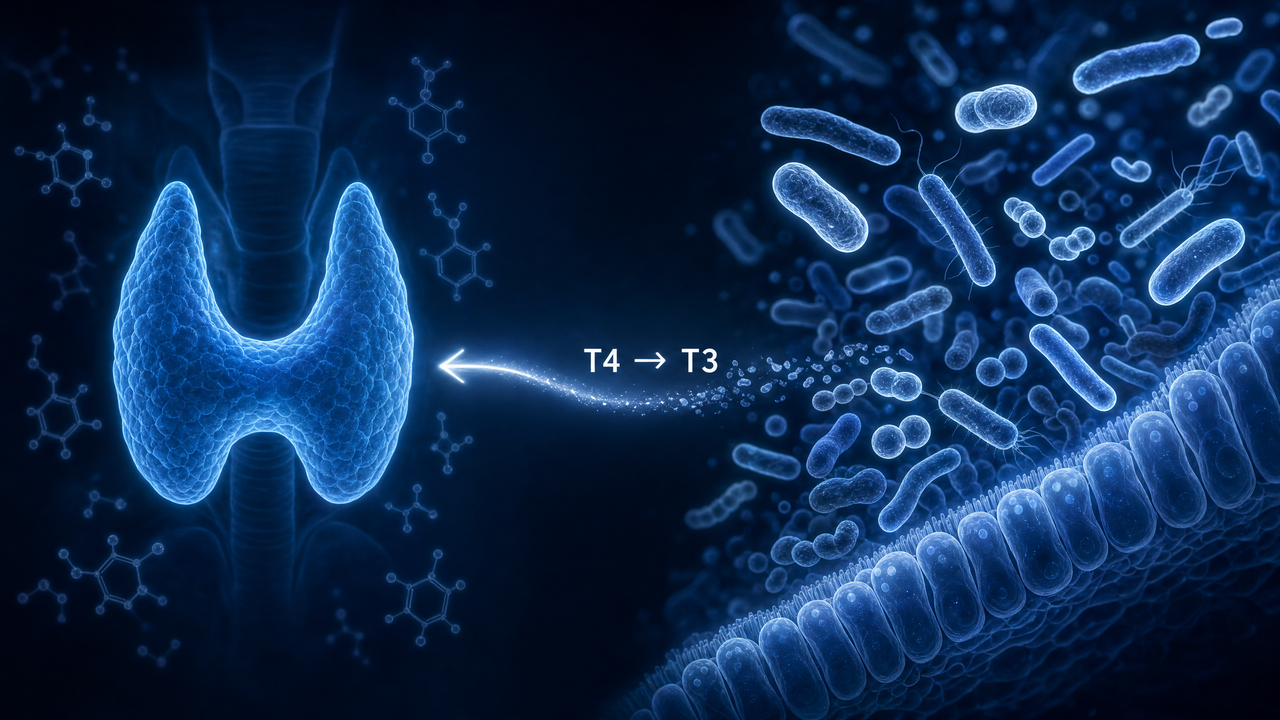
Your thyroid health and gut connection may be the missing link between your diagnosis and how you actually feel
If you've been diagnosed with a thyroid condition — or you're still searching for answers after years of symptoms — there's a layer to your health picture that rarely comes up in a standard appointment.
The thyroid health and gut connection is one of the most clinically significant and most under-discussed relationships in functional medicine, and understanding it may finally explain the gap between your diagnosis and how you feel day to day.
In this article, you'll learn how your gut microbiome directly influences your thyroid hormone levels, why chronic gut inflammation keeps the autoimmune process going, why standard thyroid panels often don't tell the whole story, and what a more complete diagnostic picture actually looks like.
There's important information further down — especially if your labs keep coming back "normal" but you still don't feel like yourself. Keep reading.
Key Takeaways
- Gut bacteria produce enzymes that help convert inactive T4 into active T3 — the hormone your cells actually use for energy, metabolism, and mood.²
- The intestinal wall contains its own deiodinase enzymes, and gut bacteria directly regulate their activity — meaning a disrupted microbiome can impair T4-to-T3 conversion.²
- Elevated zonulin — a marker of intestinal permeability (leaky gut) — has been detected in patients with Hashimoto's thyroiditis, suggesting a direct link between a compromised gut barrier and autoimmune thyroid activity.⁴
- Gut dysbiosis can drive the production of thyroid autoantibodies (TPO-Ab and TG-Ab) by triggering immune responses that cross-react with thyroid tissue.⁶
- Harmful gut bacteria reduce short-chain fatty acid (SCFA) production, which weakens immune regulation and promotes the inflammatory environment that sustains thyroid autoimmunity.⁵
- Emerging research shows a measurable connection between the oral microbiome and thyroid health markers, including TSH and TPO antibody levels.⁷
- Gut health is foundational to thyroid health — testing both systems gives you a complete picture that neither test provides alone.
Why your thyroid numbers can look fine but you still feel terrible
Here's something I see over and over: someone comes in with persistent fatigue, hair thinning, stubborn weight, cold hands, and a fog they can't shake — and their TSH is "within range."
Their doctor is satisfied. They are not.
The frustration is completely valid. And a lot of the time, the part of the picture being missed lives in the gut.
Standard thyroid panels measure TSH and sometimes T4. What they rarely assess is how much of that T4 is actually being converted into T3 — the active form of thyroid hormone that your cells use.
T4 is essentially a storage hormone. Your body needs to convert it into T3 before it can actually drive your metabolism, regulate your temperature, support your mood, and maintain your energy.
And here's what conventional workups don't account for: a significant portion of that conversion depends on the health of your gut
What your gut bacteria have to do with thyroid hormone
Your gut does a lot more than digest food. It plays an active role in how your thyroid functions — including how well your body activates thyroid hormone in the first place.
Research published in Frontiers in Nutrition confirms that gut microbiota influence thyroid hormone metabolism through multiple pathways, including the production of short-chain fatty acids (SCFAs) and the regulation of deiodinase enzyme activity — the enzymes responsible for converting T4 into active T3.¹
When those bacterial populations are disrupted or out of balance, that conversion process slows down.
The intestinal wall contains its own deiodinase enzymes, and the composition of gut bacteria directly affects how efficiently they work.²
A healthy, diverse microbiome supports this conversion process. A disrupted one compromises it.
The gut also plays a major role in absorbing the micronutrients thyroid hormone production depends on: iodine, selenium, zinc, and iron. Gut bacteria help regulate how well those nutrients are absorbed and metabolized.¹
So if your gut is inflamed or your microbiome is out of balance, you can be eating all the right foods and still not absorbing what your thyroid needs.
This is one of those places where looking at only one system — in isolation — leaves you with half the story.
The leaky gut and Hashimoto's connection
Hashimoto's thyroiditis is the most common form of hypothyroidism, and it's autoimmune in nature — meaning the immune system is generating antibodies that attack thyroid tissue.
If you have it, gut health isn't just relevant to how you feel. It may be central to why the autoimmune process started and why it continues.
Here's the mechanism: when the gut barrier becomes compromised — a condition known as increased intestinal permeability — bacterial fragments, food proteins, and other particles can cross into the bloodstream through gaps in the gut lining.
The immune system flags them as threats and mounts a response. The problem is that some of those bacterial proteins structurally resemble thyroid tissue.
This "molecular mimicry" can cause the immune system to generate antibodies that don't just target the invaders — they also target the thyroid.⁶
A study published in Frontiers in Immunology found elevated zonulin concentrations — a direct marker of intestinal permeability — in patients with Hashimoto's thyroiditis.⁴
Zonulin regulates the tight junction proteins that keep the gut barrier intact. When zonulin levels are high, that barrier is compromised. And in Hashimoto's patients, it consistently is.
A systematic review published in Gastroenterology Review reinforces this further, confirming that increased intestinal permeability and gut microbiota changes can disrupt normal immune function and contribute to autoimmune thyroid disease.⁵
This isn't a fringe theory. The research is clear: the gut is not a passive bystander in autoimmune thyroid conditions. It is actively involved.
If you're curious about how gut barrier health intersects with broader immune function, this article on healing your gut health and immune system together explores that connection in depth.
How chronic gut inflammation keeps the thyroid antibody cycle going
When harmful bacteria dominate the gut and SCFA-producing bacteria are depleted, the result is a shift in the immune environment toward chronic, low-grade inflammation.⁵
That inflammatory state doesn't just cause digestive symptoms. It keeps the immune system in a state of heightened reactivity — which, in someone with Hashimoto's, means continued production of TPO and thyroglobulin antibodies.
Research published in Frontiers in Cellular and Infection Microbiology found that harmful gut bacteria like Bacteroides and Proteobacteria disrupt SCFA balance, increase gut permeability, and allow lipopolysaccharides (LPS) to enter circulation — triggering immune cell activation and driving autoantibody production.⁶
The inflammation isn't resolved because the source — the gut — hasn't been addressed.
This is also why some people with Hashimoto's find that thyroid medication helps their labs but doesn't fully resolve their symptoms.
The medication replaces the hormone. It doesn't address the gut-driven immune activity that continues in the background.
If you've noticed that your antibody levels stay elevated despite treatment, or that your symptoms shift and change unpredictably, it's worth looking at what's happening in the gut.
You can explore the relationship between gut inflammation and mental and emotional symptoms in this piece on why gut health and mental health are the same fight.
The oral microbiome piece most people don't know about
There's another layer to this that I think deserves more attention: the oral microbiome.
Your mouth is the entry point for everything that reaches your gut. The bacteria that colonize it travel downstream daily, directly influencing gut microbiome composition.
And emerging research now shows that the oral microbiome has a measurable relationship with thyroid health markers.
A large-scale NHANES analysis published in the Journal of the Endocrine Society found that both subclinical and clinical hyperthyroidism were associated with reduced oral microbiome diversity, and that high TPO antibody levels correlated with specific oral microbiome patterns.⁷
A separate study examining the salivary microbiota of patients with thyroid nodules found that certain clinical indicators — including TSH and TPO antibody levels — were correlated with oral microbial composition.⁸
This doesn't mean your dentist should be managing your Hashimoto's. It means the full picture of what's driving your thyroid immune activity runs through systems that are rarely assessed together.
The oral cavity, the gut, and the thyroid exist on a continuum. Disruption in one place echoes through the others.
This is something we explore in depth in the Gateway to Health documentary series — currently available for a 10-day free screening.
If you haven't watched it yet, I'd encourage you to. It connects the dots between these systems in a way that's genuinely hard to find elsewhere.
Why testing both systems gives you the complete picture
The standard thyroid workup and the standard gut assessment are usually ordered separately — if the gut is assessed at all.
But given what the research shows about how deeply these systems interact, looking at them in isolation leaves significant gaps.
Thyroid hormone conversion, nutrient absorption, autoantibody production, and immune regulation are all influenced by what's happening in the gut.
If you have Hashimoto's — or symptoms that suggest a thyroid issue — knowing your gut barrier status, your microbiome composition, and your food sensitivities isn't supplemental information. It's clinically relevant information that can change the direction of your care.
This is something I talk about at length in the Interconnected series, which is available for a limited-time free viewing.
The series covers the gut-immune axis and the ways the body's systems work together in ways that conventional testing often doesn't capture. If your thyroid journey has felt incomplete, this is worth your time.
For a deeper look at what functional gut testing actually reveals — beyond standard bloodwork — this article on what functional gut health testing really reveals is a solid place to start.
Closing thoughts
Thyroid health doesn't exist in a vacuum. Neither does gut health. The research connecting them is robust, the mechanisms are well-documented, and the clinical implications are significant.
If you're managing a thyroid condition and your treatment feels incomplete, or if you've been symptomatic without a clear diagnosis, I'd encourage you to look at the gut. Not instead of your thyroid — alongside it.
The thyroid health and gut connection isn't a replacement for working with your physician. It's an expansion of what a complete picture can look like.
Because when you understand the whole system, you have a real path forward — not just a set of numbers on a lab report.

Sources
- Association Between the Newly Proposed Dietary Index for Gut Microbiota and Thyroid Function: NHANES 2007–2012, Frontiers in Nutrition, 2025
- The Relationships Between the Gut Microbiota and Its Metabolites with Thyroid Diseases, Frontiers in Endocrinology, 2022
- Relationship Between Gut Microbiota and Thyroid Function: A Two-Sample Mendelian Randomization Study, Frontiers in Endocrinology, 2023
- Detection of Alterations in the Gut Microbiota and Intestinal Permeability in Patients with Hashimoto Thyroiditis, Frontiers in Immunology, 2021
- Influence of the Increase in Intestinal Permeability and Microbiota Change in the Development of Hashimoto's Thyroiditis — Systematic Review, Gastroenterology Review, 2024
- Recent Advances in Gut Microbiota and Thyroid Disease: Pathogenesis and Therapeutics in Autoimmune, Neoplastic, and Nodular Conditions, Frontiers in Cellular and Infection Microbiology, 2024
- Exploring the Association Between Thyroid Function and Oral Microbiome Diversity: An NHANES Analysis, Journal of the Endocrine Society, 2023
- Saliva Microbiome Changes in Thyroid Cancer and Thyroid Nodules Patients, Frontiers in Cellular and Infection Microbiology, 2022