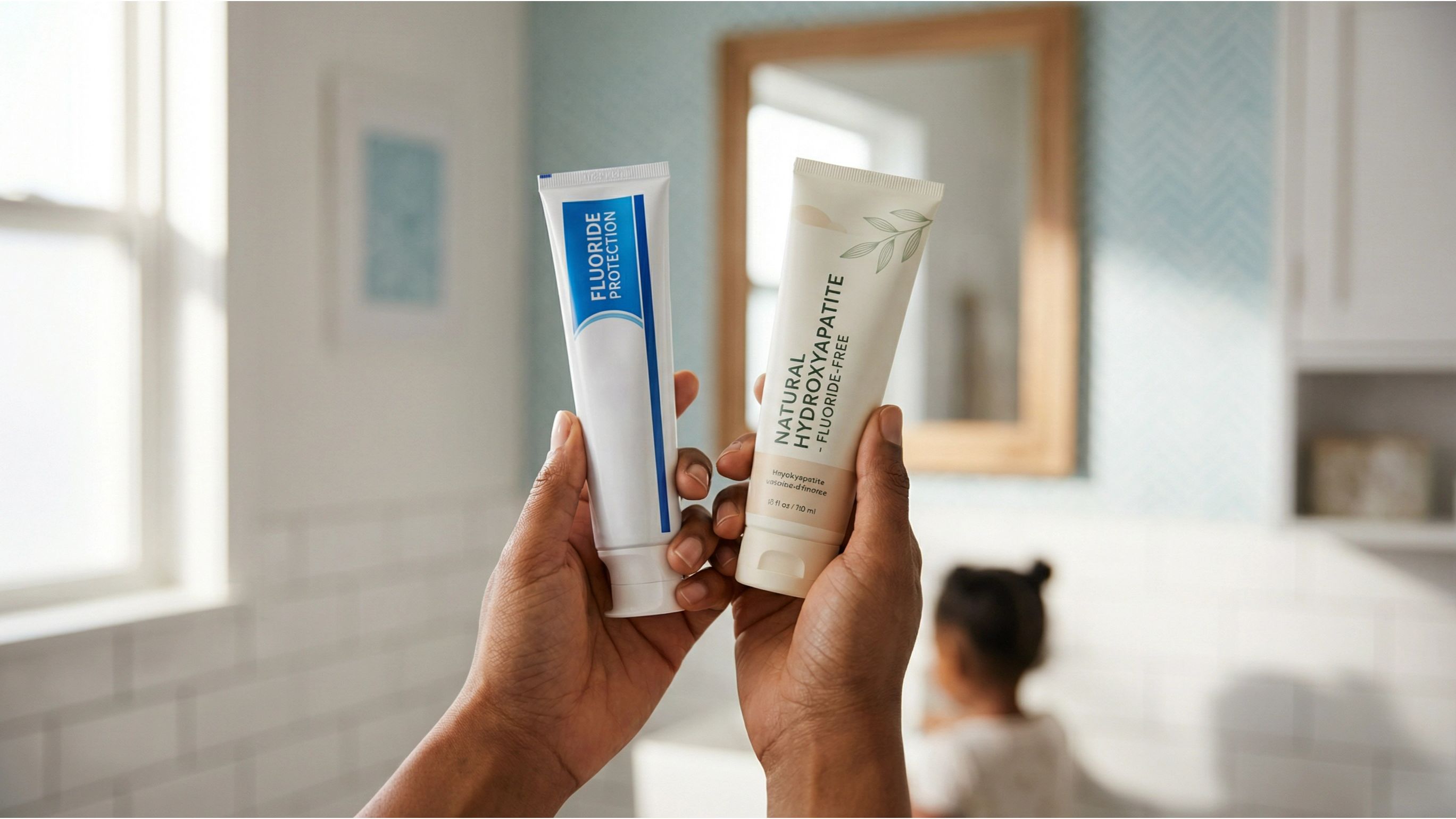
The fluoride controversy has divided dentists for decades, but the real question isn't whether fluoride works — it's whether we need to drink it
As a functional dentist, I've had countless conversations with concerned parents who feel caught in the middle of the fluoride controversy.
On one side, they hear it's essential for preventing cavities. On the other, they're reading about potential neurotoxicity and seeing white spots forming on their children's teeth.
The confusion is understandable — and honestly, it's frustrating that this debate has become so polarized.
Here's what I want you to know: this isn't about conspiracy theories or rejecting science. It's about asking better questions based on what we've learned about oral health in the last 70 years.
In this article, you'll discover why the fluoride debate isn't as simple as "pro" or "anti," what the latest research reveals about fluoride overexposure in children, and science-backed alternatives that protect teeth without the systemic risks.
Whether you're a parent trying to make the best choice for your family or someone dealing with ongoing dental issues, understanding the nuance in this conversation matters.
Keep reading — I promise the information ahead will help you make truly informed decisions about your oral health.
Key Takeaways
- The fluoride controversy centers on delivery method: topical application works, but systemic ingestion through water raises questions.
- Approximately 70% of American children now show signs of dental fluorosis, indicating widespread fluoride overexposure¹.
- Most fluoridation research dates back to the 1950s, before we understood the oral microbiome or had multiple fluoride sources.
- Nano-hydroxyapatite offers equivalent cavity protection without fluorosis risk and is safe if swallowed².
- Topical fluoride treatments at your dentist remain effective and controlled for high-risk patients.
- Testing your oral microbiome reveals your actual cavity risk, enabling personalized prevention strategies.
- The question isn't whether fluoride prevents cavities — it's whether drinking it provides benefits that outweigh the risks.
Discover the Oral-Systemic Health Connections Changing Modern Dentistry
Watch the Gateway to Health documentary series FREE for 10 days and learn how your mouth affects your entire body.
Join thousands discovering the mouth-body connection
How a 1950s Discovery Created Today's Debate
The fluoride story begins in Colorado, where dentists noticed something peculiar in the early 1900s: children in certain areas had fewer cavities but oddly mottled teeth.
By the 1950s, researchers traced both effects to naturally occurring fluoride in the water supply.
The logic seemed sound — if natural fluoride at 1 part per million (ppm) reduced cavities, why not add it to all public water?
What followed was dramatic. Childhood cavity rates plummeted. The CDC eventually called water fluoridation one of the 20th century's great public health achievements.
But here's what's changed since then: In 1950, fluoridated water was the primary fluoride source.
Today, we're exposed through multiple channels — toothpaste, processed foods and beverages made with fluoridated water, dental treatments, and supplements. This cumulative exposure matters more than most people realize.
I see parents in my practice who diligently limit sugar and brush their children's teeth twice daily, yet their kids still develop white spots or even pitted enamel.
When we trace back the fluoride sources, it's rarely just one thing.
It's the toothpaste they swallow while learning to brush, plus the tap water in their cereal, plus the foods processed with fluoridated water.
The dose makes the poison, as toxicologists say.
Fluoride Exposure: Then vs. Now
1950s Era
Fluoridated Water
Single fluoride source
2026 Reality
Tap Water
Toothpaste
Beverages
Processed Foods
Dental Treatments
Supplements
6+ cumulative fluoride sources
💡 The problem isn't fluoride itself — it's the uncontrolled cumulative exposure from multiple sources that didn't exist when water fluoridation began.
More concerning is that most water fluoridation data comes from an era when bacteria were different, diets contained less processed sugar, and we didn't understand oral microbiome dynamics.
Bacteria adapt. They evolve. Yet we're still using 70-year-old research to justify mass medication in 2026.
Want to Understand How Decades-Old Health Policies Affect You Today?
Watch the Gateway to Health series FREE for 10 days and learn the science behind functional oral health.
Discover why 1950s research doesn't answer 2026 health questions
The Fluorosis Epidemic Hiding in Plain Sight
Here's a statistic that should alarm every parent: according to NHANES data from 2015-2016, approximately 70% of American children and adolescents now have some degree of dental fluorosis¹.
Let me repeat that — seven out of ten kids.
Dental fluorosis occurs when developing teeth are exposed to excessive fluoride during the first eight years of life.
In mild cases, you see faint white lines or spots. In moderate to severe cases — which affect a growing percentage of children — the enamel becomes pitted, brittle, and prone to staining.
Some teens I treat need costly cosmetic dentistry before they even graduate high school because their enamel has literally crumbled.
Dental Fluorosis: A Growing Concern
American Children & Adolescents with Dental Fluorosis
7 out of 10 children show visible signs of fluoride overexposure
Visual representation:
Faded teeth = affected by fluorosis
Fluorosis Severity Levels
Mild
Faint white lines or spots on enamel
Moderate
More pronounced white areas, possible brown staining
Severe
Pitted, brittle enamel prone to breaking and staining
⚠️ Fluorosis indicates overexposure during the first 8 years of life when permanent teeth are forming — revealing a systemic problem with current fluoride guidelines.
Source: NHANES 2015-2016 data
Mild fluorosis is often described as cosmetic, but that's misleading. Fluorosis represents hypomineralization — weakened tooth structure.
And when approximately 70% of children show visible signs of fluoride overexposure, we can't keep calling this a minor side effect¹.
What causes this epidemic? It's the cumulative effect I mentioned earlier.
A child drinks fluoridated water, swallows fluoride toothpaste (which is inevitable when they're young), eats foods processed with fluoridated water, and maybe receives fluoride treatments at the dentist.
Each source seems "safe" in isolation, but together they exceed recommended levels during critical tooth development.
I recently worked with a mother whose six-year-old had moderate fluorosis on her permanent front teeth. "But I did everything right," she told me tearfully. "I followed all the guidelines." And she had.
The problem is that the guidelines don't account for cumulative exposure in 2026.
This is why understanding your oral microbiome balance matters more than blanket recommendations.
Not every child has the same cavity risk.
Why Topical Works But Systemic Raises Questions
Here's where functional dentistry parts ways with the "fluoride for everyone" approach: we need to distinguish between topical and systemic delivery.
Topical fluoride — applied directly to teeth during dental visits or through properly used toothpaste — works.
It strengthens enamel's surface and makes teeth more resistant to acid attacks from cavity-causing bacteria.
When controlled and not swallowed in significant amounts, topical fluoride is effective and low-risk.
Systemic fluoride — swallowed through drinking water or supplements — is the controversial part.
The original theory was that fluoride was incorporated into developing teeth from the inside out. But decades of research show that fluoride's primary benefit is topical, not systemic³.
The fluoride that ends up in your bloodstream, bones, and developing teeth? That's where potential problems arise.
Two Different Approaches to Fluoride
Topical Application
Applied directly to tooth surfaces
✓ Strengthens enamel surface directly
✓ Controlled, targeted dose
✓ Minimal systemic absorption
✓ Professional supervision available
Common forms:
Toothpaste • Professional treatments • Mouth rinses
Systemic Delivery
Swallowed and distributed through the bloodstream
? Uncontrolled cumulative dose
? Circulates through entire body
? Accumulates in bones and tissues
? No personalized dosing
Common sources:
Tap water • Food/beverages • Fluoride supplements
💡 Both methods prevent cavities, but topical application offers the same benefits without widespread systemic exposure.
Research from multiple countries has raised concerns about fluoride's effects on developing brains.⁴
27 studies have found associations between fluoride exposure and reduced IQ in children⁴.
While these studies have limitations and don't prove causation, they raise legitimate questions about whether mass water fluoridation — an approach most European countries have rejected — makes sense when topical applications provide the same cavity-prevention benefits.
I'm not saying fluoride is inherently dangerous.
I use topical fluoride treatments in my practice for patients with high cavity risk, xerostomia (dry mouth), or extensive root exposure.
But these are targeted, controlled applications for specific clinical needs — not blanket exposure for entire populations regardless of individual risk.
Think about it this way: if you have a patient with severe anxiety, you might prescribe medication. But you wouldn't add anti-anxiety medication to the entire city's water supply "just in case."
Personalized medicine means matching interventions to individual needs.
Find Out Your Actual Cavity Risk with Personalized Testing
The Orobiome Test reveals your unique bacterial profile so you get targeted solutions — not blanket recommendations.
🎯 Precision Testing
🧬 Bacterial Analysis
No more one-size-fits-all approaches to oral health
The Science That Should Make Us Reconsider
When I present these concerns to colleagues, some push back: "But the science is settled! Fluoridation works!"
The truth is more nuanced.
Yes, fluoride prevents cavities. No one disputes that.
But the question isn't "Does fluoride work?"
It's "Do the benefits of water fluoridation outweigh the risks in 2026, given what we now know?"
Consider what's changed since the 1950s research that established water fluoridation:
Bacterial evolution: The oral bacteria we're dealing with today aren't the same as 70 years ago.
They've adapted to our modern environment, including ubiquitous fluoride exposure.
We're still seeing what dental researchers call a "silent epidemic of decay" despite widespread fluoridation.
Multiple fluoride sources: In 1950, fluoridated water was novel.
Now fluoride is everywhere — toothpaste, mouth rinses, professional treatments, processed foods and beverages.
Cumulative exposure wasn't a concern then because there was only one source.
Microbiome understanding: We didn't know about the oral microbiome's role in chronic disease back then.
Now we understand that oral bacteria influence everything from heart disease to Alzheimer's.
Maintaining a balanced oral ecosystem matters as much as preventing cavities.
Personalized medicine: The 1950s approach was one-size-fits-all.
Modern medicine is moving toward personalized interventions based on individual risk factors, genetics, and biomarkers.
Why should oral health be different?
This is why I advocate for testing rather than guessing.
Your oral microbiome composition determines your actual cavity risk far more accurately than population-level statistics.
Want to Discover What's Actually Happening in Your Mouth?
The Orobiome Test analyzes your unique bacterial balance and creates a personalized protocol based on YOUR specific needs — not generic recommendations from decades-old research.
1950s population averages
✓ 2026 personalized analysis
Licensed practitioner review included with every test
Science-Backed Alternatives That Actually Work
The good news? We're not stuck choosing between cavities and fluorosis.
Modern oral science has given us effective alternatives — particularly nano-hydroxyapatite.
Nano-hydroxyapatite is a game-changer.
It's a calcium phosphate mineral that makes up to 97% of your tooth enamel by weight⁵.
When applied topically through toothpaste or rinses, hydroxyapatite particles fill microscopic pores in enamel, remineralize early lesions, and protect against acid attacks.
Clinical studies show that hydroxyapatite toothpaste performs as well as fluoride toothpaste in preventing cavities⁶.
Multiple randomized trials have found equivalent or superior remineralization with hydroxyapatite compared to fluoride².
And here's the crucial difference: if your child swallows hydroxyapatite toothpaste while learning to brush, it's safe².
Accidentally ingested hydroxyapatite particles dissolve in the stomach into calcium and phosphate ions with no adverse effects under realistic doses².
Beyond hydroxyapatite, other evidence-based alternatives include:
Xylitol: This natural sugar alcohol raises oral pH, making it harder for cavity-causing bacteria to thrive.
Research shows xylitol chewing gum significantly reduces mutans streptococci in dental plaque when used long-term⁷.
pH-balancing approaches: Alkaline mouth rinses (pH 8.5) help neutralize the acidic conditions that cause demineralization.
Sodium bicarbonate offers gentle natural whitening while creating an environment that discourages harmful bacteria.
Supporting nutrients: Vitamins K2 and D3 enhance calcium absorption — not just for bones but for teeth.
Vitamin C strengthens gum tissue. Prebiotics like inulin support beneficial oral bacteria.
Modern delivery systems: Products using these ingredients often combine multiple mechanisms — remineralization, pH balance, and microbiome support — for comprehensive protection.
The key is understanding that cavity prevention isn't just about one ingredient.
It's about creating an oral environment where beneficial bacteria thrive and teeth can naturally remineralize.
What I Recommend to My Patients
When parents ask me "What should I do about fluoride?" here's my honest answer:
For topical application: Yes to professional fluoride treatments if your child (or you) has high cavity risk, multiple existing cavities, or specific vulnerabilities like dry mouth from medications.
These controlled applications provide benefits without significant systemic exposure.
For water fluoridation: Consider filtering fluoride from drinking water, especially for young children during tooth development.
This gives you control over total fluoride exposure.
For toothpaste: For children under 6, choose fluoride-free options with nano-hydroxyapatite.
They can't control swallowing yet, and cumulative exposure matters. For older children and adults, it depends on cavity risk — which brings me to my next point.
For personalized protocols: Test, don't guess.
Oral microbiome testing reveals your actual bacterial composition and cavity risk.
Someone with excellent oral bacteria and good salivary pH might not need any fluoride.
Someone with aggressive cavity-causing bacteria might benefit from targeted topical treatments.
The questions to ask your dentist are: What's MY actual cavity risk? How much fluoride am I getting from ALL sources? Would targeted topical treatment work better than systemic exposure?
This is where functional dentistry differs from conventional approaches.
We don't apply the same solution to everyone.
We identify root causes — is it diet? Bacterial imbalance? Dry mouth from medications? Genetic factors? — and address those specifically.
Discover Your Personalized Oral Health Protocol
The Orobiome Test analyzes your unique bacterial balance and creates a customized plan — no guesswork, no generic advice.
DNA-level bacterial analysis
Licensed practitioner consultation
Customized protocol for YOUR mouth
Join thousands taking control of their oral health with personalized testing
The Future of Oral Health Is Personalized, Not Generalized
I'm not anti-fluoride. I'm pro-informed choice and pro-personalization.
Topical fluoride has earned its place in dentistry for specific clinical situations. But 1950s-era mass water fluoridation? We can do better in 2026.
We have better tools, better understanding, and better options.
The real fluoride controversy isn't about whether it works — it clearly does in topical form.
It's about whether outdated, one-size-fits-all policies make sense when we now have personalized alternatives that work just as well without the risks.
Our teeth may benefit from fluoride, but do we need to drink it? Do our children need to ingest it during critical developmental years when we have equally effective alternatives they can safely swallow?
These are fair questions. Asking them doesn't make you anti-science. It makes you a thoughtful consumer of healthcare who understands that medicine evolves — and so should our public health policies.
Your oral health affects everything from your cardiovascular system to your cognitive function to your immune response. It's too important to leave to generic recommendations based on population averages from seven decades ago.
You deserve to understand what goes into your body and your children's bodies. You deserve personalized protocols based on your actual bacterial composition and risk factors. You deserve options that don't require choosing between cavity protection and fluorosis risk.
That's functional oral health. And it's available right now.
Ready to Move Beyond Guesswork?
Explore the Orobiome Test and get personalized treatment based on your unique oral microbiome.
🦷 DNA-level bacterial analysis
📋 Custom protocol from licensed practitioners
🎯 Targeted solutions for YOUR mouth

Sources
- A National Study Exploring the Association Between Fluoride Levels and Dental Fluorosis. JAMA Network Open. 2023.
- The use of hydroxyapatite toothpaste to prevent dental caries. Odontology. 2021.
- The Fluoride Debate: The Pros and Cons of Fluoridation. Preventive Nutrition and Food Science. 2018.
- Developmental fluoride neurotoxicity: a systematic review and meta-analysis. Environmental Health Perspectives. 2012.
- Synthetic hydroxyapatite: a perfect substitute for dental enamel in biofilm formation studies. Scientific Reports. 2025.
- Comparative efficacy of a hydroxyapatite and a fluoride toothpaste for prevention and remineralization of dental caries in children. BDJ Open. 2019.
- Effects of Xylitol in Chewing Gum on Dental Plaque and Streptococcus mutans. Journal of Food and Drug Analysis. 2006.