Root canal health risks and systemic health connections you should understand before treatment
When your dentist recommends a root canal, you're likely focused on relieving the immediate pain. But what if I told you there's more to consider than just saving that tooth?
Understanding root canal health risks isn't about fear — it's about making empowered decisions with complete information.
In my practice, I've seen patients struggle with chronic health issues that seem unrelated to their dental work.
One patient came to me with persistent fatigue and unexplained inflammation markers.
After testing her oral microbiome, we discovered significant dysbiosis and recommended she get a cone beam CT scan from her dentist.
The scan revealed a low-grade infection in a root canal-treated tooth. Once we addressed it, her systemic symptoms began to improve.
Conventional dentistry excels at preserving teeth through root canal procedures, and for many patients, these treatments work beautifully.
But the oral-systemic health connection reveals that what happens in your mouth doesn't stay in your mouth.
Approximately 15 million root canals are performed annually in the United States¹, making this one of the most common dental procedures.
That's precisely why you deserve to understand both the benefits and the root canal health risks before moving forward.
In this article, you'll discover how root canals relate to whole-body health, what biological dentistry offers that conventional approaches may miss, and the questions you should ask before any major dental intervention.
Whether you choose to proceed with treatment or explore alternatives, you'll leave with the knowledge to advocate for your health.
Keep reading — the information ahead could change how you think about your dental health.
Key Takeaways
- Root canals have a reported success rates between 86-98% when properly performed⁴, but long-term success rates decline to approximately 60% after 20 years.²
- Failed root canal signs include persistent pain, swelling, recurring infections, and unexplained systemic symptoms.
- Research shows associations between chronic endodontic infections and cardiovascular disease, with infected teeth showing 1.38 times higher CVD risk.³
- Biological dentistry approaches focus on complete disinfection protocols, biocompatible materials, and consideration of systemic health impacts.
- Oral microbiome testing before major interventions helps identify bacterial imbalances that may affect healing.
- Root canal alternatives include extraction with implant, ozone therapy with remineralization, and in some cases, watchful monitoring.
- Understanding both conventional and functional dentistry perspectives empowers better decision-making for your long-term health.
What Happens During Root Canal Treatment
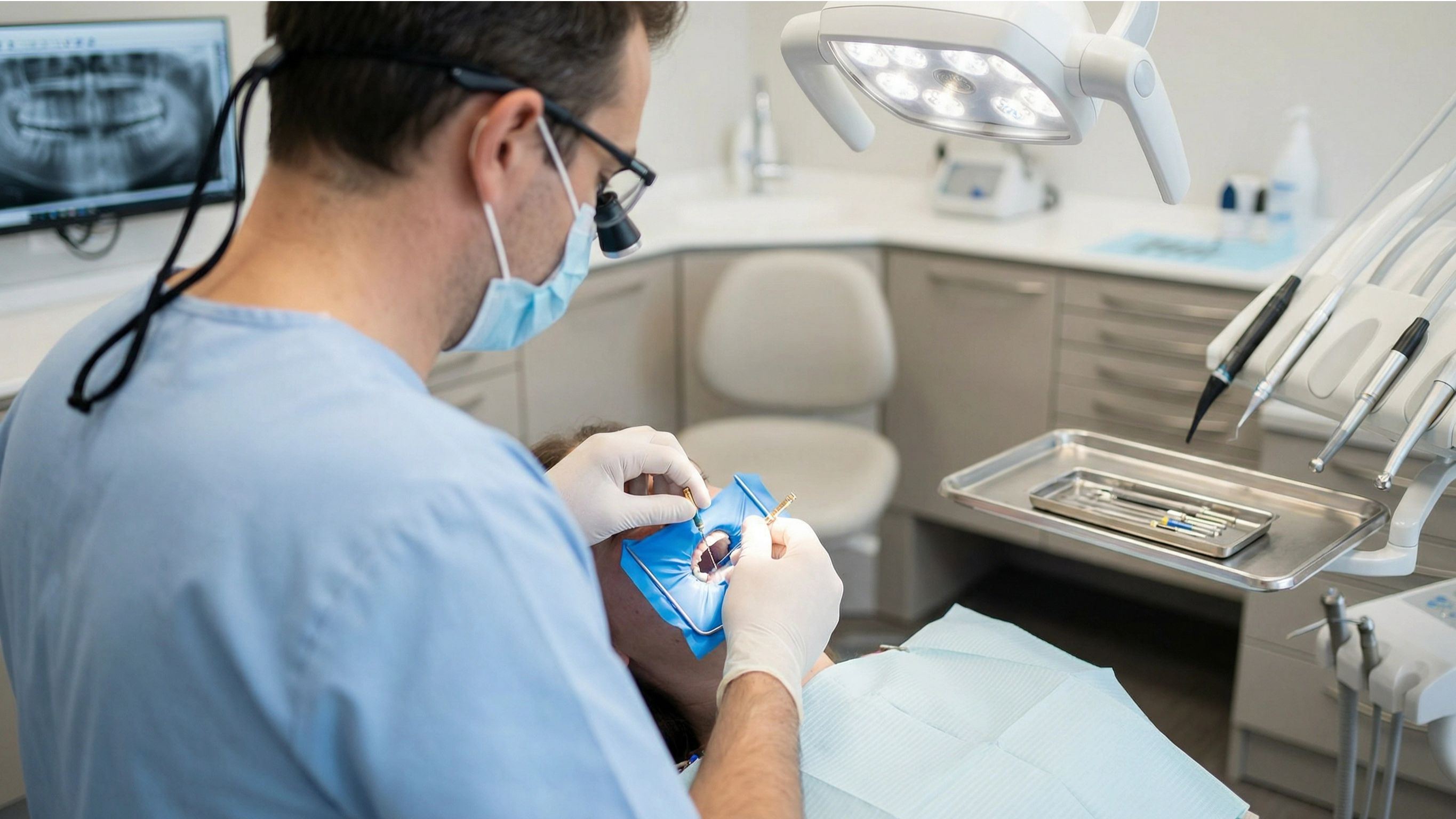
A root canal becomes necessary when the dental pulp — the soft tissue containing nerves and blood vessels inside your tooth — becomes infected or inflamed.
The procedure involves removing this infected tissue, thoroughly cleaning the canal system, and sealing it to prevent reinfection.
Conventional dentistry reports success rates between 86-98% for properly performed root canals⁴.
Many patients experience complete relief and keep their treated teeth for decades. These procedures save countless teeth from extraction every year, preserving natural tooth structure and bite function.
However, success depends heavily on multiple factors:
- the severity of infection before treatment,
- the complexity of the tooth's canal system,
- the quality of the restoration placed afterward,
- and most importantly, whether all bacteria have been adequately removed during the procedure.
The challenge? Teeth contain microscopic tubules throughout the dentin — thousands of them.
Even with advanced cleaning techniques, completely sterilizing these tubules remains difficult. This is where functional dentistry begins asking different questions about root canal health risks.
The Systemic Health Considerations
The relationship between root canal health risks and whole-body wellness extends far beyond your tooth. Understanding these connections helps you make truly informed decisions about treatment.
Understanding the Oral-Gut-Body Connection
Your mouth serves as the gateway to your entire body.
Every time you swallow, you send bacteria down into your digestive system. Between 0.75 and 1.5 liters of saliva — containing approximately 1 billion bacteria per milliliter — are produced and swallowed daily⁵,⁶.
When a root canal procedure leaves behind bacterial reservoirs — even small ones — those microbes can affect more than just your tooth.
Research on chronic endodontic infections reveals compelling associations with systemic health.
A 2021 systematic review found that patients with chronic endodontic infections had 1.38 times higher risk of cardiovascular disease compared to those without these infections³. While this doesn't prove direct causation, it highlights an important connection worth considering.
The mechanism makes biological sense: bacteria from infected root canal systems can enter your bloodstream during routine activities like chewing, brushing, or dental cleanings. These oral pathogens have been found in atherosclerotic plaques and heart valve tissue⁷.
The inflammatory mediators your body produces in response to chronic oral infection don't stay localized — they circulate systemically, potentially contributing to cardiovascular problems and other chronic conditions.
When Root Canals Don't Heal as Expected
Studies show that root canal success rates decline over time. While immediate success rates are high, long-term follow-up reveals that approximately 60% of treated teeth remain successful after 20 years².
This doesn't mean the tooth is lost, but it does indicate that healing isn't always permanent.
Failed root canal signs to watch for include:
- Persistent sensitivity to pressure or temperature
- Recurring gum swelling or abscess formation
- Visible bone loss on three-dimensional cone beam CT scans
- Unexplained chronic inflammation or fatigue
- Sinus issues (particularly with upper molars)
One of my patients reported what seemed like unrelated symptoms — brain fog, low energy, and elevated inflammatory markers. Conventional medical tests found nothing conclusive.
When we tested her oral microbiome and recommended she get a cone beam CT scan from her dentist, we discovered a chronic infection at the apex of a root canal-treated tooth.
The infection had been silently impacting her system for years.
This doesn't mean all root canals fail or cause systemic problems.
But it does emphasize why understanding your oral microbiome and monitoring treated teeth over time matters for your overall health. Testing your oral bacteria can reveal imbalances that conventional X-rays might miss.
A Functional Dentistry Approach
What Biological Dentistry Adds to Root Canal Decisions
Functional dentistry doesn't oppose root canals — it expands the conversation. A holistic dentist considers not just tooth preservation, but how treatment decisions affect your entire system.
Key differences in the biological root canal approach include:
Enhanced Disinfection Protocols: Beyond standard techniques, some practitioners use ozone therapy to achieve deeper disinfection of the canal system and surrounding bone. Ozone's antimicrobial properties can reach areas traditional irrigants miss.
Biocompatible Materials: Not all filling materials trigger the same immune response. Precision dentistry involves testing which materials your body tolerates best, reducing the risk of chronic low-grade inflammation.
Microbiome Testing First: Understanding your baseline oral bacterial population helps predict healing capacity. Some bacterial profiles suggest higher risk for persistent infection after root canal treatment.
PRF (Platelet-Rich Fibrin) Techniques: Using your body's own healing factors concentrated from your blood can support tissue regeneration and reduce infection risk after procedures.
3D Imaging for Complete Assessment: Cone beam CT scans reveal bone quality and infection signs that traditional 2D X-rays cannot detect. This technology helps identify problems before they become serious.
In my practice, when a patient needs endodontic treatment, we first assess their oral microbiome.
If we find significant dysbiosis — bacterial imbalance — we work to optimize their oral ecosystem before any procedure.
This isn't about avoiding necessary treatment; it's about ensuring the best possible outcome by addressing the underlying environment.
Exploring Your Options Beyond Standard Treatment
Root Canal Alternatives Worth Discussing
Understanding root canal health risks naturally leads to the question: what are my alternatives?
Extraction with Implant: Removing the tooth and replacing it with a dental implant eliminates the infected tissue completely.
Modern implants have high long-term success rates, often exceeding 95% over 10-year periods⁸. However, this option involves surgery, healing time, and higher initial costs.
Extraction with Bridge: A traditional fixed bridge uses adjacent teeth as anchors. This preserves bone better than leaving an empty space but requires modifying healthy neighboring teeth.
Ozone Therapy and Remineralization: For early-stage infections or cracks that haven't completely compromised the pulp, ozone therapy combined with mineral support can sometimes avoid root canal treatment entirely. This works best when caught early.
Regenerative Endodontics: This emerging field uses stem cell principles to help damaged pulp tissue regenerate rather than removing it completely. It's not widely available yet but represents an exciting future direction.
Strategic Monitoring: In select cases where a tooth shows signs of infection but isn't causing acute symptoms, careful monitoring with regular cone beam imaging might be appropriate. This isn't ignoring the problem — it's gathering information to make the best decision at the right time.
The key is understanding that no single approach works for everyone.
Your immune function, the specific bacteria present, your overall health status, and your personal priorities all factor into the best choice for you.
Questions to Ask Before Your Procedure
Whether you proceed with a root canal or explore alternatives, ask these questions:
- What does my oral microbiome test reveal about bacterial balance?
- Can I get a cone beam CT scan to fully assess the infection and bone quality?
- What are the specific root canal health risks in my case based on my health history?
- What root canal alternatives should I consider given my situation?
- If we proceed, what enhanced disinfection protocols will be used?
- How will we monitor the tooth's healing over time?
- What are the biological root canal options using biocompatible materials?
- If this is retreatment, what failed root canal signs indicate the original procedure isn't successful?
- What role does my systemic health play in healing capacity?
- Can you explain both the conventional approach and the holistic dentist perspective?
Don't hesitate to seek a second opinion, especially for complex cases.
Your dentist should welcome informed questions — they indicate you're an engaged partner in your health care.
The Gateway to Health Philosophy
At Gateway to Health, we believe in testing before treating.
Your mouth harbors a unique ecosystem of bacteria — some beneficial, some potentially harmful.
Before any major dental intervention, oral microbiome testing provides a baseline understanding of what you're working with.
This test-first philosophy applies equally whether you're considering a root canal, dealing with chronic oral inflammation, or simply wanting to optimize your oral health.
When you understand your bacterial balance, you can make targeted interventions rather than one-size-fits-all approaches.
The oral-systemic health connection means your dental decisions impact far more than just your teeth.
That infection in your mouth? It's connected to your cardiovascular system, your gut health, your immune function, and your inflammatory status.
Understanding these connections doesn't mean avoiding necessary dental treatment — it means approaching it with complete information.
Conclusion
Root canals aren't inherently good or bad — they're a procedure that works brilliantly for some patients and poses challenges for others.
The key is understanding root canal health risks in the context of YOUR unique health situation.
If you're facing a root canal decision, remember: you have time to gather information. Ask questions. Seek practitioners who consider both conventional excellence and systemic health implications.
Consider oral microbiome testing before major interventions. And most importantly, trust that informed decisions — whatever they are — will serve you better than fear-based ones.
Your oral health is too important to leave to chance. Whether you proceed with treatment, explore alternatives, or need time to gather more information, you deserve complete transparency about your options.

Sources
- Endodontic Facts. American Association of Endodontists. 2026.
- What ultimately matters in root canal treatment success and tooth preservation: A 25-year cohort study. Int Endod J. 2023.
- Cardiovascular Disease and Chronic Endodontic Infection. Is There an Association? A Systematic Review and Meta-Analysis. Int J Environ Res Public Health. 2021.
- Failure of endodontic treatment: The usual suspects. Eur J Dent. 2016.
- The oral microbiome: Role of key organisms and complex networks in oral health and disease. Periodontol 2000. 2021.
- The role of the oral microbiome in obesity and metabolic disease: potential systemic implications and effects on taste perception. Nutr J. 2023.
- Association between Endodontic Infection, Its Treatment and Systemic Health: A Narrative Review. Medicina. 2022.
- Modern implant dentistry based on osseointegration: 50 years of progress, current trends and open questions. Periodontol 2000. 2016.